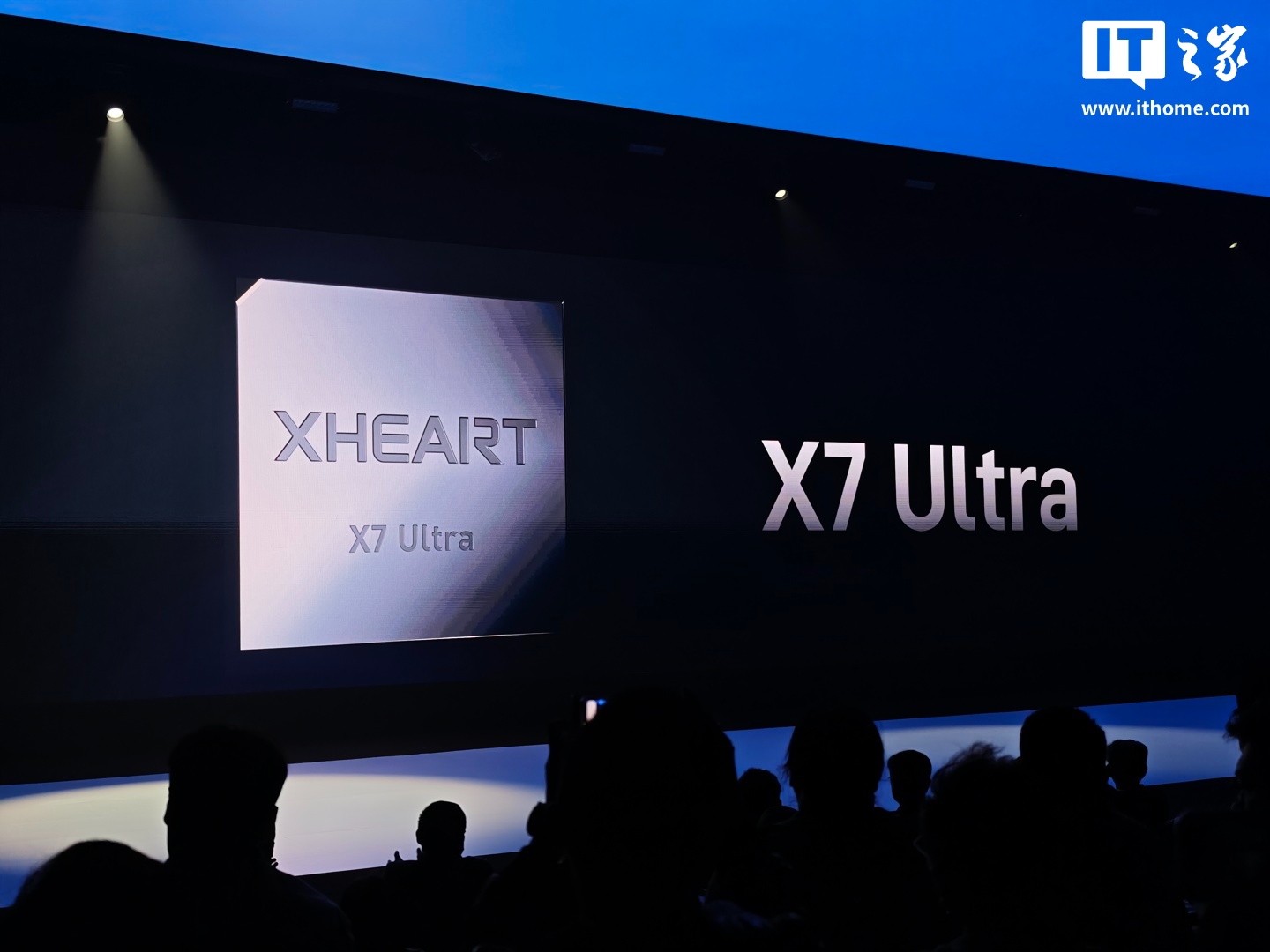
XHEART, a prominent name in the automotive technology sector, has officially unveiled its latest innovation, the X7 Ultra, a large model chip designed to redefine the future of intelligent driving. At the heart of this groundbreaking chip is the core philosophy of ‘defining chips by large models,’ with an architecture meticulously crafted to meet the demands of real-world mass-produced models. The X7 Ultra boasts an impressive 700 TOPS of large model computing power, marking a significant leap forward in AI acceleration for vehicles.
Rethinking Chip Design for AI-Driven Vehicles
Speaking at the launch, XHEART CEO Li Zonglin highlighted the evolving landscape of intelligent driving. He explained that as the industry transitions from multiple small models to integrated, end-to-end large models, chip design methodologies must also adapt. XHEART’s strategic decision from its inception in 2023 was to approach chip architecture from the ground up, driven by the specific requirements of actual application models. This backward-design approach involves a complete re-organization of computing, storage, and data flow, while crucially leaving ample room for future model advancements.
X7 Ultra: Key Features and Performance
The X7 Ultra is engineered with a powerful NPU (Neural Processing Unit) featuring an ultra-large core architecture. This design dramatically enhances internal data interaction speeds, achieving TB/s-level improvements compared to inter-core communication. To support the massive data needs of large models, the chip incorporates a multi-level cache architecture that supports high capacity and concurrency, effectively reducing inference latency and power consumption.
A standout feature of the X7 Ultra is its dedicated large model operator acceleration engine. This engine provides extreme hardware optimization for critical Transformer model operators such as Layernorm, Softmax, and Transpose. It natively supports high-precision FP16/FP32 vector calculations, ensuring the accuracy and integrity of complex AI models. The NPU’s unlockable hardware parallelism is designed to fully unleash the inference potential of large models, achieving a remarkable 98.7% computational utilization rate. In comparisons with industry-leading products, the X7 Ultra demonstrates an 80% reduction in memory bandwidth consumption and a 100% improvement in energy efficiency.
China’s First Mass-Produced Armv9 Automotive-Grade CPU
Further bolstering its capabilities, the X7 Ultra introduces China’s first mass-produced Armv9 automotive-grade CPU. This new CPU offers a 20% performance boost and a 10% increase in energy efficiency. The integrated large cluster architecture enhances multi-core collaboration and L3 cache performance. Additionally, the inclusion of the new SVE2 vector processing engine provides significantly stronger DSP capabilities compared to the previous generation’s NEON technology.
XHEART’s X7 Ultra chip represents a significant stride in the development of chips tailored for the next generation of intelligent vehicles. By focusing on the specific demands of large AI models and integrating advanced CPU and NPU technologies, XHEART is positioning itself at the forefront of automotive AI innovation.