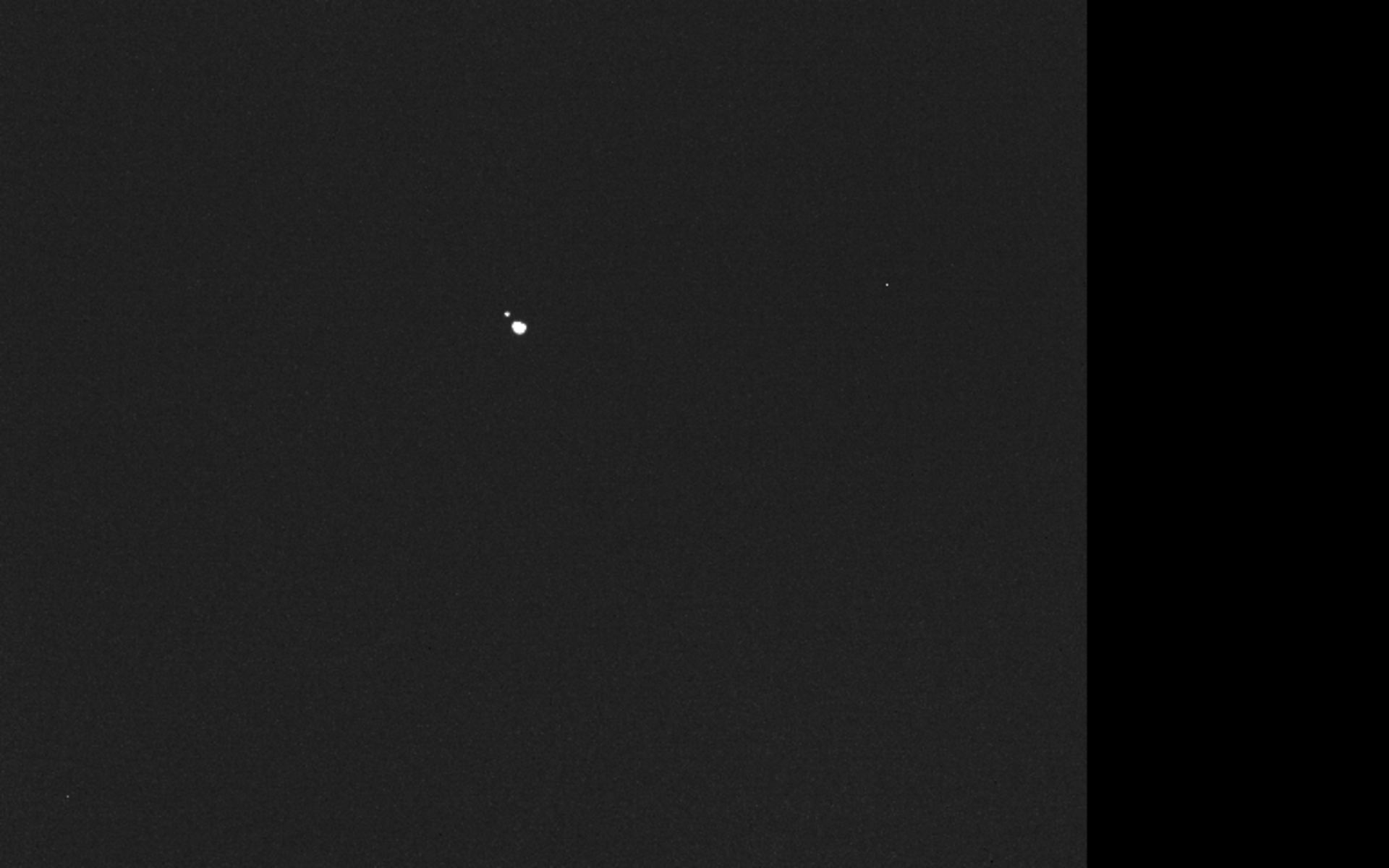
The European Space Agency’s (ESA) Hera spacecraft has achieved a significant milestone in its planetary defense mission, capturing its first images that distinctly resolve the two target asteroids, Didymos and its moonlet Dimorphos, as separate bodies. This groundbreaking observation, made from a distance of 1,280 kilometers, marks the first time the mission has independently identified the binary nature of the asteroid system, located a staggering 197 million kilometers from Earth.
First Glimpse of a Double Asteroid System
The image, taken on the evening of Friday, October 18th, by Hera’s monochromatic Asteroid Framing Camera, reveals Dimorphos, previously appearing as a single dot within the Didymos system. “With this image the smaller Dimorphos asteroid becomes visible for the first time,” explained Michael Kueppers, a key member of the mission team. “Before this acquisition the spacecraft was still resolving the Didymos system as a single dot. But now, even though Dimorphos is made up of only around one pixel in this initial image, it is clearly well separated from its parent body.” This visual confirmation comes after successful braking maneuvers, which precisely slowed Hera to just 20 meters per second relative to the asteroids, allowing for a controlled approach.
A Celestial Investigation of a Human-Altered World
The Didymos system, specifically Dimorphos, is of immense scientific interest due to its role in humanity’s first deliberate act of asteroid deflection. In 2022, NASA’s DART spacecraft intentionally collided with Dimorphos, altering its orbit by approximately 33 minutes. Hera’s mission is to meticulously investigate the aftermath of this impact. Scientists aim to understand:
- The precise effects of the DART impact on Dimorphos’s structure, including whether a crater was formed or the asteroid was significantly reshaped.
- The detailed composition, internal structure, and mass of Dimorphos.
- The specific properties that led to a greater-than-predicted orbital deflection.
“For the very first time we are seeing through Hera’s own eyes the very double asteroid system that the mission was designed and built for,” stated mission manager Ian Carnelli. “Our views will much grow sharper as Hera comes closer. We will unveil the first detailed images of Dimorphos – the first object in the Solar System to have had its orbit measurably shifted by human action – on 25 November.” Over the coming months, Hera will conduct a close-up investigation of the ‘crash site,’ deploying two shoebox-sized CubeSats for even more detailed surveys, culminating in a potential landing on the asteroid.