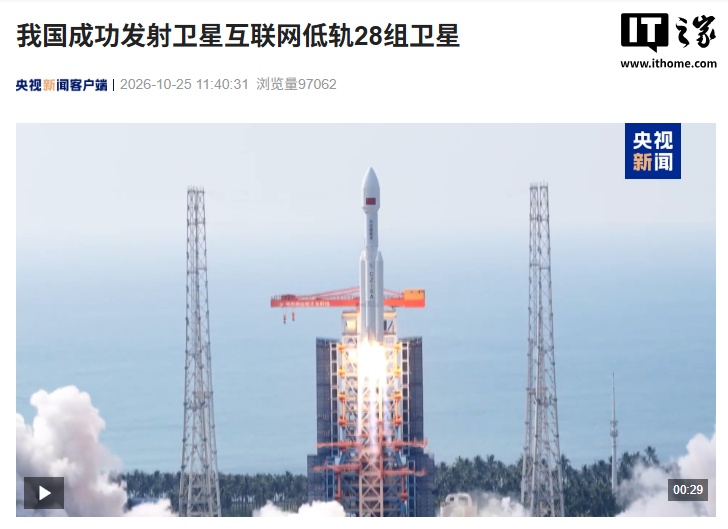
China has successfully launched a batch of 28 satellites for its low-orbit satellite internet constellation. The launch took place on October 25, 2026, at 10:03 AM Beijing time, from the Hainan Commercial Aerospace Launch Site. The satellites were carried into orbit by the Long March 8A carrier rocket, a key component of China’s burgeoning space program.
Long March 8A: A Workhorse for Constellation Deployment
The Long March 8A rocket, developed by the First Academy of China Aerospace Science and Technology Corporation (CASC), is a two-and-a-half-stage liquid-propellant launch vehicle. It features a 3.35-meter diameter liquid oxygen/kerosene core stage and a 3.35-meter diameter hydrogen/oxygen core stage, augmented by two liquid boosters. Its 5.2-meter fairing is designed to accommodate the demanding requirements of deploying large satellite constellations in medium and low Earth orbits.
This rocket made its maiden flight in February 2025 and has significantly increased China’s launch capabilities. Its payload capacity to a 700 km sun-synchronous orbit has been boosted from 5 tons to 7 tons compared to its predecessor, the Long March 8. A notable feature is its upper stage’s multiple ignition capability, allowing for extended in-orbit coasting and phased satellite deployment. The entire rocket stands approximately 50.5 meters tall and has a liftoff weight of about 371 tons.
The GW Constellation: China’s Ambitious Satellite Internet Plan
The newly launched satellites are part of the ‘Satellite Internet Low-Orbit’ series, belonging to the China Star Network (GW constellation). This initiative represents China’s first satellite internet program and is also envisioned as its first integrated space-air 6G satellite internet plan.
The GW constellation is meticulously planned, with a total of 12,992 satellites slated for deployment. It is divided into two sub-constellations: GW-A59 and GW-A2. The GW-A59 is planned to comprise 6,080 satellites, primarily operating in orbits below 500 kilometers. The GW-A2 constellation will consist of 6,912 satellites, positioned at an orbital altitude of approximately 1,145 kilometers.
According to the deployment schedule, the GW constellation aims to have approximately 1,300 satellites in orbit by the end of 2029. The full constellation, comprising all 12,992 satellites, is targeted for completion by 2035. These ‘Satellite Internet Low-Orbit’ series satellites are developed by the Fifth Academy of CASC.
A Busy Launch Schedule and Recent Milestones
The launch of these 28 satellites marks another significant step in the rapid deployment of the GW constellation. The constellation officially entered its construction phase on December 16, 2024, with the successful launch of the ’01 group’ of satellites in a ‘one rocket, ten satellites’ configuration.
Since then, the series has entered a period of intensive launches. Notably, the ’26 group’ of low-orbit satellites was launched on September 23, 2026, using the Long March 8A rocket from Hainan. Subsequently, the ’27 group’ was launched on October 10, 2026, aboard a Long March 12 rocket, also from the Hainan Commercial Aerospace Launch Site.
Demonstrating Advanced Capabilities
In a significant demonstration earlier in October 2026, the GW constellation achieved its first real-time video communication across the North and South Poles. During this test, the video transmission latency was recorded at less than 1 second, with peak upload and download speeds reaching approximately 30 Mbps.
This achievement validates the communication capabilities of China’s domestic satellite internet system under diverse environmental conditions, including extreme cold and high altitudes. The technologies and equipment developed for this project are also expected to find applications in other critical areas such as emergency rescue operations and maritime communications.
This latest launch underscores China’s commitment to developing a robust and comprehensive satellite internet infrastructure, poised to play a crucial role in future communication technologies and national space strategy.