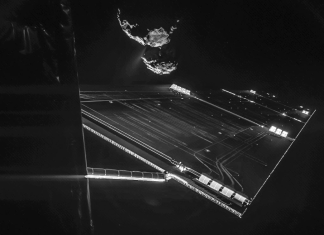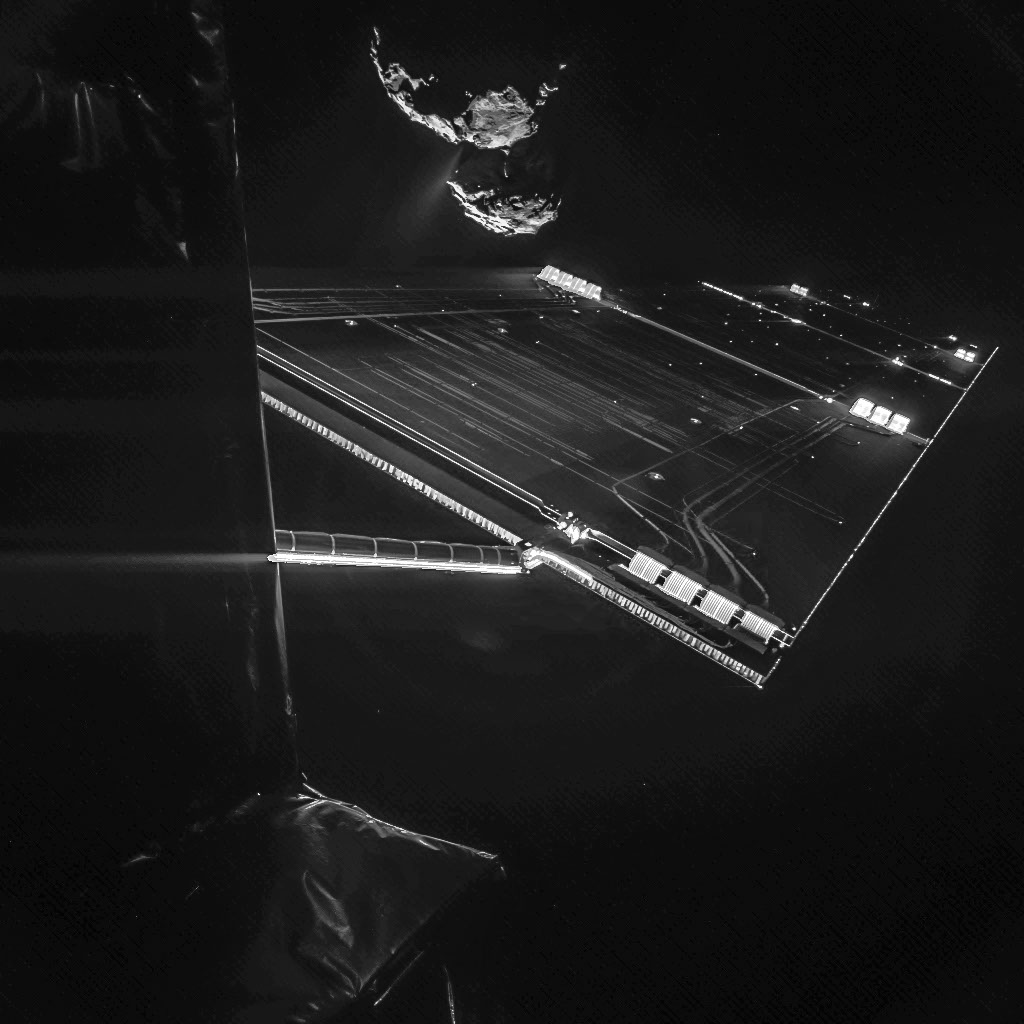
In a stunning celestial snapshot, the European Space Agency’s Rosetta spacecraft captured its own ‘selfie’ on October 7, 2014, offering a unique perspective of its target comet, 67P/Churyumumov-Gerasimenko. At the time, Rosetta was an astonishing 472 million kilometers (293 million miles) from Earth, yet remarkably only 16 kilometers (10 miles) above the comet’s intriguing, double-lobed surface. This image is a testament to the incredible engineering and scientific ambition that allowed humanity to get so close to a comet.
Capturing Comet 67P in Its Glory
The ‘selfie’ showcases the dramatic interplay of light and shadow on comet 67P/Churyumumov-Gerasimenko. Dust and gas stream away from the comet’s nucleus, illuminated by the distant Sun. Glinting brilliantly in the harsh sunlight is one of Rosetta’s two 14-meter (46-foot) long solar arrays, a vital component that powered the mission’s extensive exploration. The high-contrast scene was masterfully captured using the CIVA camera system aboard Rosetta’s Philae lander, which was still attached to the orbiter at the time. Two exposures, one short and one long, were combined to bring out the intricate details of this distant world.
Philae’s Final Farewell to Rosetta
This iconic image also marks a significant moment in the Rosetta mission: it was the last photograph taken by Philae’s camera before its planned separation from the Rosetta orbiter on November 12, 2014. Philae was designed to land on the comet’s surface, and its chosen primary landing site was on the visible hemisphere of the smaller lobe of the nucleus. Shortly after detaching from Rosetta, Philae captured one final image looking back at its mothership, before embarking on its historic descent to the comet’s surface, a journey that provided invaluable data about cometary composition and behavior.
Source: NASA