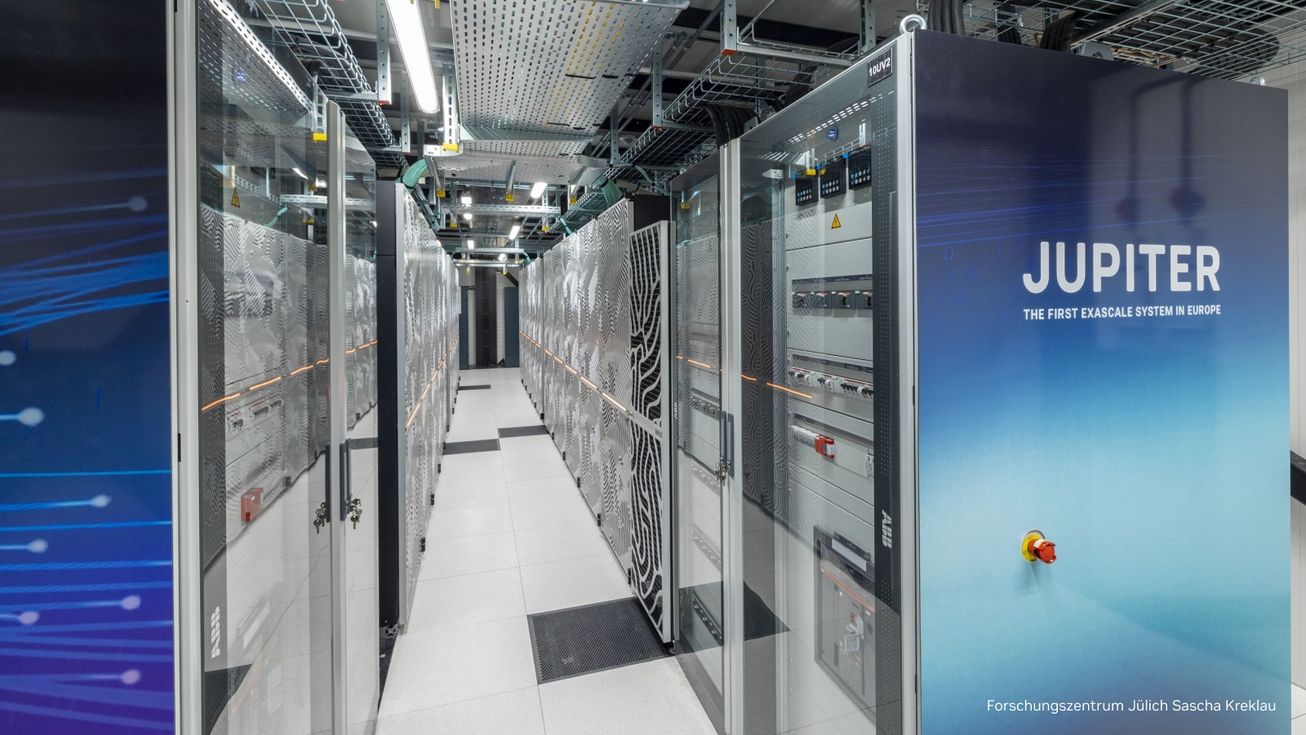
NVIDIA has announced a groundbreaking, large-scale simulation of fault-tolerant quantum computing performed on JUPITER, Europe’s first exascale supercomputer located at the Jülich Supercomputing Centre (JSC). This simulation marks a significant milestone in the pursuit of practical quantum applications.
The simulation encompassed 104 qubits and represents the most extensive complex modeling of a fault-tolerant quantum computing system to date. Crucially, it fully replicates the operation of a real quantum processor during fault-tolerant calculations, a feat previously unachieved in any simulation.
This breakthrough validates a promising approach to quantum computing known as magic state cultivation. This method requires 90% fewer physical qubits compared to prior techniques, dramatically accelerating progress toward developing useful quantum applications in fields such as drug discovery, financial modeling, and materials science.
Simulations on JUPITER provide the quantum industry with tangible data on the impact of noise on fault-tolerant quantum computations. This intelligence will empower researchers to refine designs for future quantum processors before they are physically built, potentially shaving years off the timeline to functional quantum computers.
“Useful quantum computing will require incredibly complex, fault-tolerant systems, and understanding their behavior at scale is key to building them,” said Jensen Huang, founder and CEO of NVIDIA. “Our results from Jülich demonstrate how quantum processors and GPU-powered supercomputers can work together to tackle research challenges previously beyond reach, accelerating the discovery of transformative quantum applications.”
Christel Michalsen, Director of the Jülich Supercomputing Centre, added, “Europe’s investment in JUPITER empowers researchers to explore questions previously out of reach. By partnering with NVIDIA, we are extending this capability to quantum computing, helping scientists make more informed decisions about the designs most likely to lead to useful applications.”
Reducing Resources for Useful Quantum Computing
As qubits operate at the edge of physical possibility, the interactions required for their control introduce unavoidable, error-inducing noise. Computing in the presence of such noise—fault-tolerant quantum computing—necessitates the use of magic states. These are specific qubit configurations that are constantly consumed during fault-tolerant quantum computations.
Fault-tolerant quantum computers are critically dependent on the repeated creation of magic states. Any optimization in this creation process significantly eases the construction of a useful quantum computer.
By simulating this process under realistic noise conditions, NVIDIA researchers have validated the state-of-the-art magic state cultivation approach, providing tools for developing and testing future improvements.
Previously, the Jülich Centre simulated 50 qubits under ideal, noise-free conditions. The new work models magic state cultivation under realistic hardware noise, aiding researchers in understanding the impact of errors.
From Development to Exascale Simulation
Simulating magic state cultivation helps evaluate and refine designs before building quantum hardware. However, the required memory can grow exponentially with the number of qubits, rendering large-scale simulations inaccessible to traditional computing systems.
NVIDIA’s GB200 NVL72 system at NVIDIA’s Accelerated Quantum Computing Research (NVAQC) served as the development platform for the JUPITER project, allowing tests to scale from four to hundreds of GPUs before moving to JUPITER’s 8192 GPUs.
Researchers used the center to accelerate the development and testing of their simulation methods, compare results with JUPITER, and study accuracy scaling relative to computational resources. This work reduced simulation times from weeks to days, preparing the team for efficient utilization of JUPITER’s exascale computing power.
The project underscores how simulations will become increasingly vital and complex as quantum systems grow larger. It also highlights the utility of accelerated computing clusters like NVAQC, which enable researchers to develop and validate simulation methods before leveraging world-class supercomputers for the most demanding computations.
The simulations were performed using NVIDIA cuQuantum software for highly optimized performance and scale, and the fault-tolerant logical layer of the NVIDIA CUDA-Q platform to express the magic scheme.