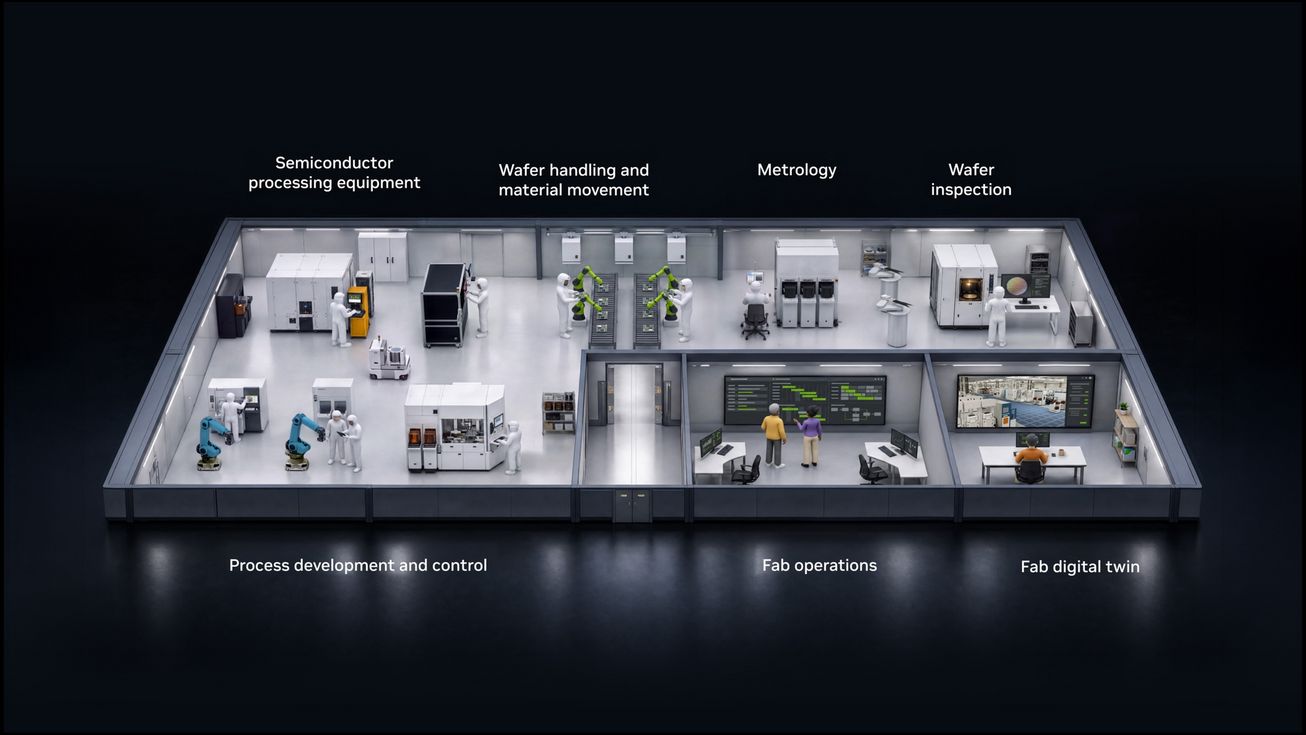
NVIDIA is announcing significant advancements in artificial intelligence (AI) for semiconductor design and manufacturing. Leading industry players, including Applied Materials, Cadence, KLA, Lam Research, and Siemens, are actively adopting NVIDIA’s innovations to build what they call “AI-defined fabs.”
AI-defined fabs represent semiconductor facilities where AI is employed to optimize processes, resolve manufacturing challenges, and enhance overall efficiency. As the demand for complex chips escalates, these factories must scale production while managing increasingly intricate technological processes. Engineers require novel methods for material modeling, inspection data analysis, and testing changes in digital twins before implementing them in actual production.
New cuPotential Library Accelerates Atomic Interaction Modeling
A key innovation is NVIDIA’s new cuPotential library, part of the CUDA-X suite. This library empowers developers to create AI agents capable of simulating atomic and molecular interactions. Preliminary data suggests cuPotential accelerates already GPU-optimized workflows by 2-3x.
“The semiconductor industry made the AI revolution possible. Now, AI is transforming how chips are created,” said Tim Costa, vice president of NVIDIA. “As fabs strive to meet demand for leading-edge chips, NVIDIA’s CUDA-X libraries and Omniverse provide AI agents with accelerated tools for simulation and inspection, helping engineers manage complexity, improve yield, and advance AI-defined fabs.”
Synopsys is already leveraging cuPotential to accelerate materials simulations. When combined with cuEST and cuDSS, Synopsys QuantumATK demonstrates a potential 30x acceleration, while S-Device shows a 12x improvement.
Accelerating Manufacturing Processes with CUDA-X
The expanded CUDA-X ecosystem offers AI agents and engineering applications accelerated tools for semiconductor simulation, 3D data processing, and image analysis. This enables greater automation of engineering tasks across design and manufacturing stages, allowing fabs to more accurately predict process behavior and boost product yield.
Key NVIDIA CUDA-X applications in the industry include:
- NanoVDB: An open-source library for working with 3D data, accelerating simulations in semiconductor manufacturing. Lam Research is integrating NanoVDB into its SEMulator3D platform, anticipating up to a 30x acceleration in wafer etch simulation.
- NVIDIA NPP: A GPU-accelerated image processing library that speeds up chip inspection. KLA has achieved a 50x performance gain using a new NPP CUDA core.
- cuLitho: Accelerates calculations for chip pattern printing. Siemens is using cuLitho to accelerate its Calibre software.
- PhysicsNeMo: A framework for training physics-informed AI models. Luminary is applying PhysicsNeMo to semiconductor package design, enabling exploration of 100x more designs.
Integration with Leading Companies
Cadence is integrating NVIDIA Nemotron and CUDA-X to create AI agents for electromechanical system design and simulation. For instance, the Cadence AuraStack AI Super Agent optimizes advanced thermal and voltage management packages 8x faster, thanks to cuDSS.
COMSOL is using NVIDIA cuDSS to accelerate multiphysics simulations in semiconductors by up to 10x. Voltai is employing AI agents and NVIDIA cuDSS GPU-accelerated solvers for complex electro-thermo-mechanical simulations, reducing computation time from months to a single day.
ChipAgents is developing specialized AI models for chip design using NVIDIA’s infrastructure and is working on a new Build-A-Chip Bench benchmark to evaluate a semi-autonomous engineering process.
Anticipated Industry Impact
Teradyne is utilizing NVIDIA NPP and accelerated computing for image sensor testing, achieving approximately an 85x acceleration in analysis to identify worn probes before they impact product yield.
Advantest has integrated NVIDIA Nemotron and Kumo-Anomaly into ACS RTDI for real-time semiconductor manufacturing analytics. Advantest systems powered by NVIDIA Grace Blackwell provide diagnostics and recommendations for corrective actions.
Applied Materials is implementing NVIDIA Omniverse and CUDA-X to accelerate camera simulations and create digital twins of fabs, optimizing layout and material flow.
FANUC, Foxconn, OMRON, and Analog Devices Inc. are also utilizing NVIDIA solutions for simulating robotic systems, analyzing inspection data, and developing intelligent agents for manufacturing processes.
Availability: NVIDIA cuPotential is available for early access. NanoVDB is open-source as part of OpenVDB, and NPP is accessible through the NVIDIA CUDA Toolkit.