NVIDIA has announced a significant expansion of access to its cutting-edge technologies for the European scientific community. This initiative aims to bridge the gap between private sector support and European research endeavors through open educational resources, collaborative partnerships, and the provision of substantial computing power.
At the recent “AI in Science” summit in Dublin, the European Commission unveiled the “AI in Science Enablers” Initiative. This initiative, linked to the European platform RAISE (Resource for AI Science in Europe), is designed to bring private sector support closer to European research communities.
NVIDIA is joining this campaign with a commitment to provide:
- Access to accelerated tools, models, and platforms.
- Computing resources, cloud services, data, and scientific materials.
- Skills, training, and technical support.
- Collaborative projects and pilot studies, alongside support for researchers and talented specialists.
- Support for startups and ecosystem development.
“Europe’s ambitions in AI for science can only become a reality when we combine the strengths of our research community, industry, and other partners,” stated Ekaterina Zaharieva, European Commissioner for Startups, Research, and Innovation. “Through the ‘AI in Science Enablers’ campaign, we are turning these ambitions into concrete commitments, giving researchers access to the tools, expertise, and resources they need to innovate.”
Open Models and Tools
NVIDIA’s commitments begin with its open-source technologies. The company has already released over 250 open models, 250 datasets, and more than 1,400 open-source projects covering large language models, healthcare, robotics, climate science, physics AI, autonomous vehicles, and scientific research. These resources are accessible on platforms such as Hugging Face and GitHub.
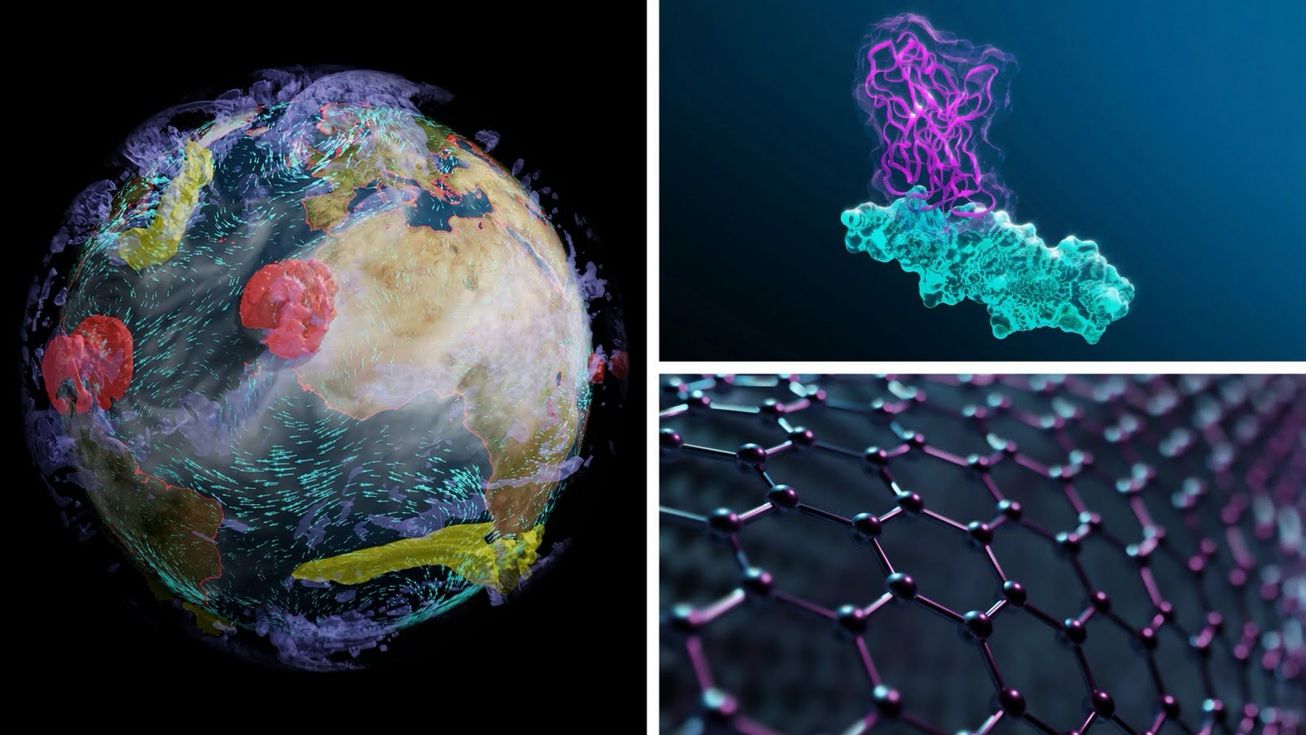
Leveraging this open ecosystem, researchers will be able to build reasoning-enabled agent systems using NVIDIA Nemotron, a family of architectures, open weights, open-source models, training data, and recipes. Scientific software will also be available, including the NVIDIA BioNeMo Agent Toolkit, NVIDIA PhysicsNeMo libraries, NVIDIA Earth-2 models, and NVIDIA ALCHEMI NIM microservices, all designed to accelerate research in biology, chemistry, molecular design, weather and climate, energy, engineering, physics, and materials science.
Skills and Training
To build advanced AI capabilities across Europe, knowledge needs to be disseminated as freely as computing power. The NVIDIA Deep Learning Institute has launched a new open-source software hub featuring hands-on training materials for accelerated computing and deep learning. These materials are available for free download under an open license, requiring no registration, payment, or time limits.
The modular structure of these courses allows for adaptation into university programs, training at supercomputing centers, or developer community events, serving as a direct pathway to NVIDIA’s broader training and certification programs.
Access to Computing Resources
NVIDIA is collaborating with cloud infrastructure partners and national AI centers in Europe (including in France, Spain, and Sweden) to open new avenues for startups and small and medium-sized enterprises (SMEs) to access sovereign European computing power and services.
The NVIDIA Inception program for startups provides access to computing resources and technical support, lowering the barrier to entry for startups seeking high-performance infrastructure and technological education.
AI2F in France is the first AI center to partner with the Inception program for four months, demonstrating significant results. AI Factory BSC conducted a pilot initiative and is now deploying its first full acceleration program, with growing interest from other national AI centers in Europe to replicate this model in 2027. Beyond supporting startups, this program is designed to achieve a broader strategic goal: fostering self-sustaining AI enterprises in Spain and Europe.
Sweden AI Factory, one of 19 EuroHPC-funded AI centers, has announced a collaboration with NVIDIA to provide access to its infrastructure and expertise to Inception program startups and SMEs across sectors such as life sciences and materials, autonomous systems, and gaming.
Finally, EuroHPC supercomputing centers, such as CINECA and JSC, are offering academic institutions and startups free access to NVIDIA GPU infrastructure and services for open research. NVIDIA complements this access with consultation hours, training, and hackathons that assist researchers in optimizing models on their own datasets. For instance, NVIDIA is co-organizing the European AI Hackathon this month with Austrian Scientific Computing, Leibniz Supercomputing Centre, High-Performance Computing Center Stuttgart, and The Cyprus Institute for Pharos-CY.
Expanding AI Infrastructure
Furthermore, NVIDIA is facilitating the most ambitious AI infrastructure expansion in Europe to date, with 35 supercomputers currently under development across the continent. This represents the largest annual volume of supercomputing capacity build-out Europe has ever witnessed.
Collectively, these systems will provide over 3 million researchers with next-generation infrastructure, accelerating discoveries in fields such as climate science, drug development, materials research, and more.