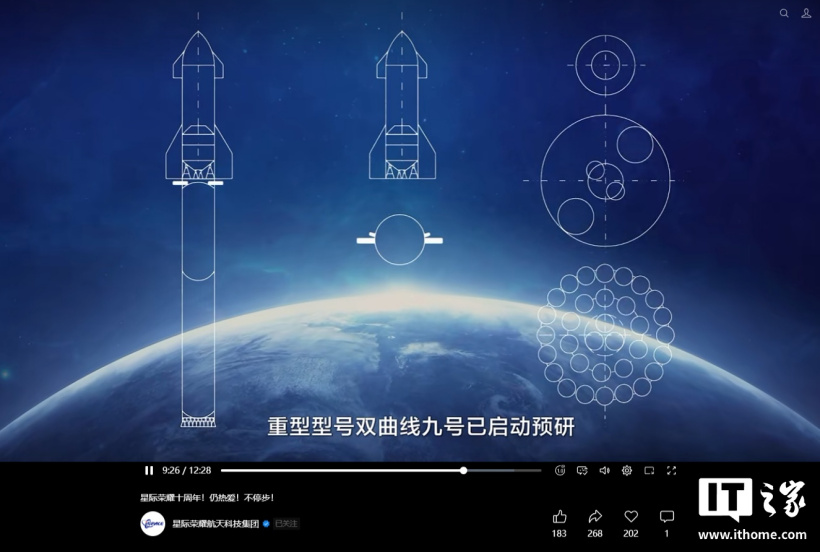
Interstellar Glory (星际荣耀), a prominent player in China’s commercial space sector, has officially announced the preliminary research and development phase for its heavy-lift launch vehicle, dubbed ‘Hyperbola-9’ (双曲线九号). The announcement was made as part of the company’s tenth-anniversary celebrations, signaling a significant step towards more ambitious space exploration missions.
Hyperbola-9: A Glimpse into Future Capabilities
While specific details are still emerging, initial plans for the Hyperbola-9 (SQX-9) indicate a formidable rocket designed to meet the demands of challenging missions. These include crewed lunar landings, Mars exploration, and deep space ventures. According to information shared previously by blogger @卡尔达瓦里希, the Hyperbola-9 is envisioned to have a payload capacity of approximately 100 tons to Low Earth Orbit (LEO) and 50 tons to Lunar Transfer Orbit (LTO).
The rocket is planned to feature a substantial diameter of 11 meters, with a liftoff thrust estimated at 7000 tons. Interstellar Glory is considering a two-stage tandem basic configuration, along with an extended three-stage tandem configuration for greater mission flexibility.
Reusability as a Core Design Principle
A key highlight of the Hyperbola-9 project is its focus on reusability. The design reportedly aims for full reusability of both stages. The first stage is intended for vertical recovery, a technology that Interstellar Glory has been actively developing. For the second stage, the plan involves technical validation through aerodynamic deceleration and vertical landing.
The propulsion system for the first stage is expected to utilize 33 units of 300-ton-class high-pressure staged combustion liquid oxygen methane engines. The second stage will be powered by a combination of two ground-version (with gimbaling capability) and two vacuum-version (fixed) engines.
Interstellar Glory’s Evolving Rocket Portfolio
The Hyperbola-9 joins Interstellar Glory’s existing and planned family of launch vehicles under the ‘Hyperbola’ series. This lineup currently includes:
- Hyperbola-1 (SQX-1): A small solid-propellant launch vehicle.
- Hyperbola-2 (SQX-2Y): A reusable technology demonstrator rocket.
- Focus-1 (JD-1): An engine development.
- Hyperbola-3 (SQX-3): A medium-to-large reusable liquid oxygen methane launch vehicle.
- Focus-2 (JD-2): A liquid oxygen methane engine.
Notably, the Hyperbola-3 (SQX-3) is being developed to cater to high-frequency, large-scale space transportation needs, such as future constellation deployment and space station cargo resupply. This rocket has already completed full-scale production and is currently undergoing testing and verification. Its maiden orbital flight and sea recovery are planned for 2026.
The development of the Hyperbola-9 signifies Interstellar Glory’s ambition to move beyond current capabilities and contribute to humanity’s expansion into the solar system. The company’s commitment to reusability underscores a drive towards more sustainable and cost-effective space access.