The European Space Agency (ESA) has announced the commencement of the most critical phase of its Hera mission, launched two years ago. The spacecraft, roughly the size of a small car and currently traveling at high speed towards its destination, is preparing for complex braking maneuvers. This is essential for the probe to safely approach the Didymos and Dimorphos binary asteroid system.
Journey to the Stars: From Launch to First Deceleration
The Hera mission lifted off from the Kennedy Space Center in Florida on October 7, 2023, shortly before the powerful Hurricane Milton. Since then, the spacecraft has been orbiting Earth, utilizing gravitational laws and executing orbital maneuvers. A significant event was its flyby of Mars in the spring of 2025, which altered the probe’s course and increased its velocity. Hera is now traveling relative to Earth at over 12 kilometers per second, crossing Mars’ orbit and nearing the Didymos asteroid pair.
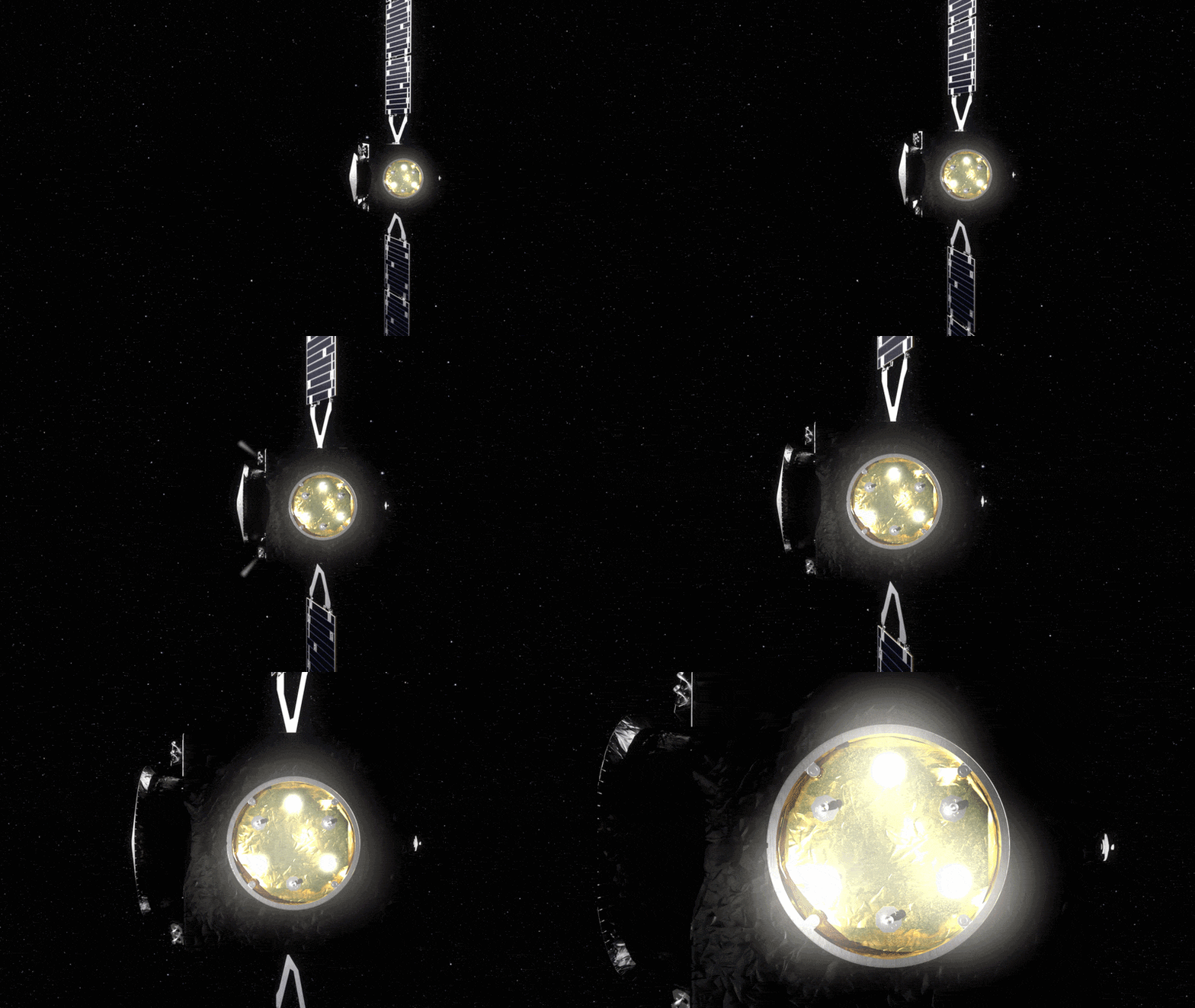
To successfully reach its objective, Hera must significantly reduce its speed. On Tuesday, October 15, the first of a series of braking maneuvers (BRM-1) is scheduled. The probe will orient itself so that its Orbit Control Thrusters are directed towards the Didymos system. Three hydrazine-fueled thrusters will fire simultaneously for 93 minutes to reduce Hera’s velocity relative to the asteroids by several hundred meters per second.
This maneuver demands precise control, as Reaction Control Thrusters will be simultaneously engaged to stabilize the spacecraft’s attitude and fine-tune the main thrusters. “To prepare for this first braking maneuver, known as BRM-1, we conducted a short test firing on October 2, after which we began generating the full command sequence,” explained Francesco Castellini, ESA’s flight dynamics engineer.
A Second Chance and Scientific Discoveries
Immediately after the completion of the first braking maneuver, the signal from the spacecraft will be received by one of ESA’s 35-meter Deep Space Antennas in Australia. It is then that the most complex work will begin: analyzing data from the Guidance, Navigation, and Control (GNC) system sensors, as well as received telemetry and Doppler data to assess the accuracy of the velocity change.
After several days of checks and calculations, a second, shorter braking maneuver (BRM-2) will be performed early on October 22. This approximately 31-minute engine firing is intended to complete the primary speed reduction needed to synchronize with Didymos’ orbit, as well as compensate for any deviations from planned parameters during BRM-1. At the end of the month, three more minor “transition” maneuvers will be conducted, bringing Hera’s relative velocity to the Didymos system down to almost zero.
The primary objective of the Hera mission is to study the asteroid Dimorphos, which orbits its parent body, Didymos. Dimorphos became the first celestial object whose orbit was altered by human activity. In 2022, NASA’s DART probe intentionally collided with Dimorphos, changing its orbit. Hera will conduct a detailed investigation of the ‘impact site’ to gather crucial data on the asteroid and its reaction to the DART impact, which will help address vital questions in the field of planetary defense.
About the Hera Mission:
- Target: Investigation of the Didymos and Dimorphos binary asteroid system.
- Launch: October 7, 2023.
- Tasks: Studying the impact of a spacecraft collision on an asteroid, collecting data on its composition and structure.
- Goal: Improving the understanding of asteroid dynamics and developing planetary defense strategies.