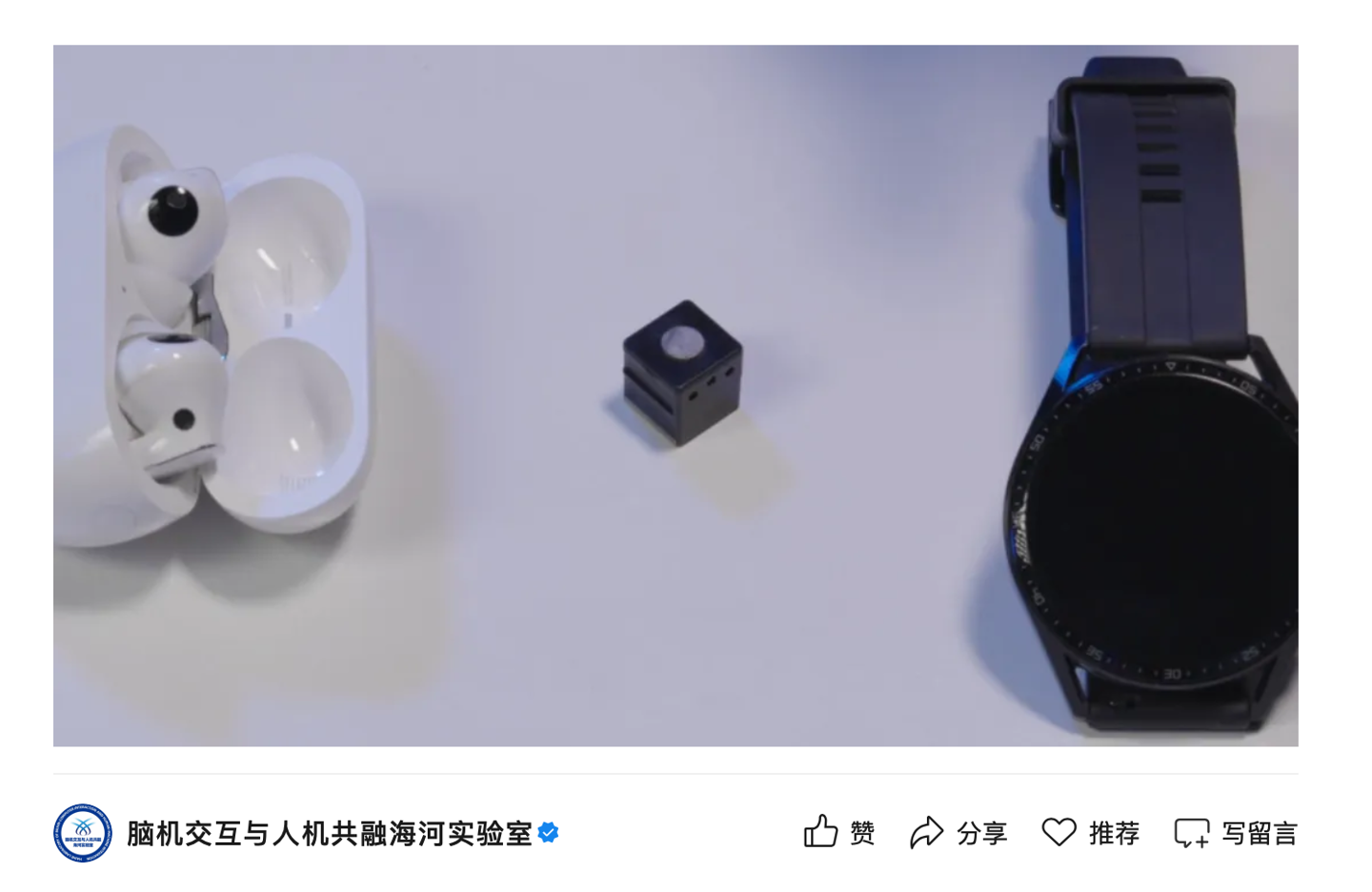
Chinese scientists have unveiled a groundbreaking innovation in the field of neurointerfaces: the ‘ShenGong · XuMi · BrainCube’ system. This development marks the introduction of the world’s smallest and lightest non-invasive brain-computer interface (BCI).
Ultra-Lightweight and Compact Design
Developed collaboratively by Tianjin University Haihe Laboratory’s Brain-Computer Interaction and Human-Machine Integration Lab and ShenGong Diting (Tianjin) Technology Co., Ltd., the ‘ShenGong · XuMi · BrainCube’ system tips the scales at a mere 3 grams and boasts a volume of less than 2 cubic centimeters. This makes it the most compact and lightest non-invasive BCI system available today.
In contrast to traditional, bulky devices like helmets or headbands, the ‘ShenGong · XuMi · BrainCube’ integrates electrodes, circuitry, a battery, and wireless data transmission into a tiny, discreet unit. Its innovative design allows for secure attachment to the scalp, concealed beneath hair. The ultra-lightweight nature ensures a virtually imperceptible wearing experience, opening up extensive possibilities for applications in medicine, consumer electronics, and industry.
High Performance and Reliability
The system’s key performance indicators meet the national standard for medical devices, GB 9706.226-2021. This certification signifies that the ‘ShenGong · XuMi · BrainCube’ is capable of accurately and consistently capturing even the faintest brain signals.
With a high sampling frequency of 1000 Hz, the device can operate for 8 to 10 hours on a single charge. This extended battery life enables prolonged, uninterrupted sessions of computer interaction via brain signals, which is crucial for many medical and research applications.
Potential Application Areas
The laboratory team is already leveraging this system to develop core technologies and pilot projects. Specifically, with support from units focused on special operations and emergency situations, research is underway with leading enterprises and educational institutions. The objective is to create safety models for control using BCIs and intelligent wearable devices for personnel engaged in hazardous tasks.
This development holds immense potential for enhancing safety and operational efficiency in extreme environments, as well as for advancing new interfaces in healthcare and personal technology.
Source: ithome.com