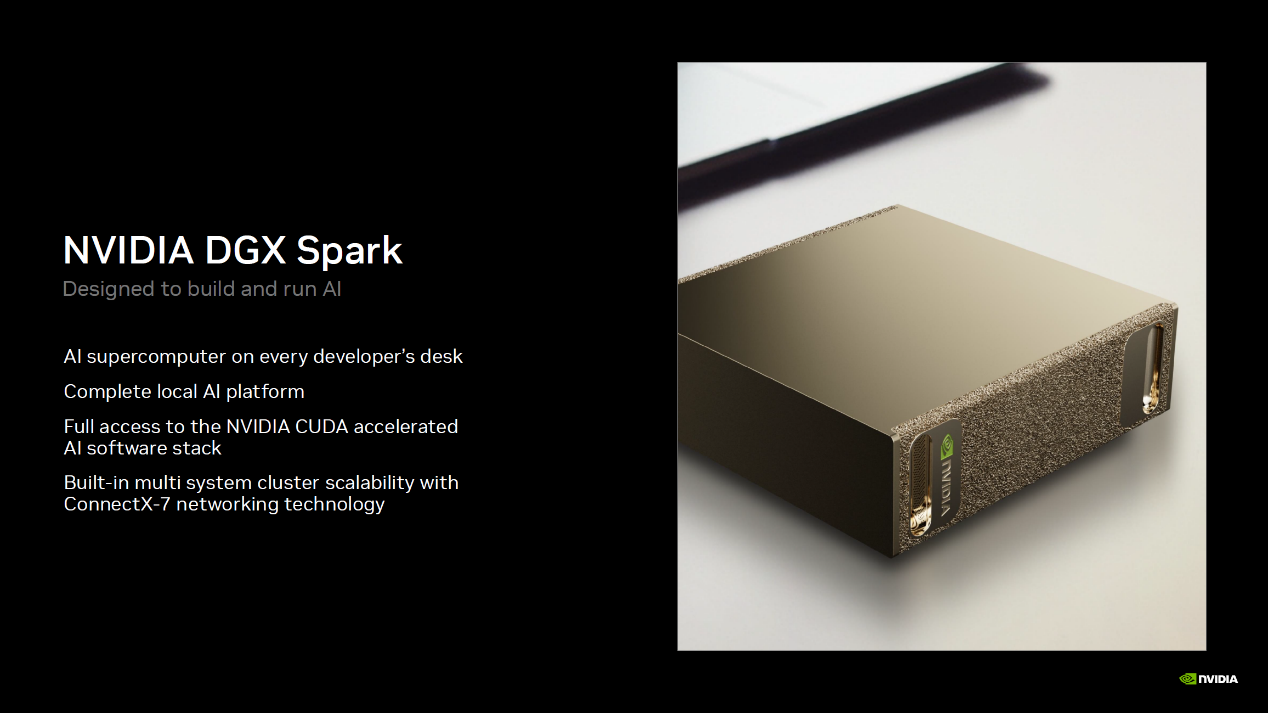
NVIDIA has officially unveiled an updated version of its DGX Spark desktop AI computer, now featuring a 64GB memory configuration. This new offering aims to lower the barrier to entry for AI development and research, with a starting price of $4,999. The 64GB DGX Spark is slated for release on October 23rd, and will be available through a variety of OEM partners including Acer, Dell, ASUS, Gigabyte, MSI, and H3C.
A More Accessible AI Workstation
The DGX Spark platform is built around the GB10 Grace-Blackwell supercomputing chip, utilizing a unified memory architecture that bridges CPU and GPU memory spaces. The new 64GB model offers a total system memory of 64GB, with approximately 8GB reserved for the system. This leaves about 56GB available for model weights and KV cache, supporting the NVFP4 quantization format. This configuration is capable of smoothly deploying and running popular open-source large language models such as Gemma 4 26B, Qwen 3.8-27B, Meta Muse Glimmer, and Nemotron 3.5 Lightning, with ample memory remaining for KV caching to facilitate long-context inference tasks.
NVIDIA has also updated the pricing for the previously released 128GB version of the DGX Spark FE, which will now retail for $6,950.
Seamless Multi-Node Clustering for Developers
One of the standout features of the DGX Spark is its native multi-node cluster expansion capability. Equipped with a built-in ConnectX-7 high-speed network card and the new NVIDIA Sync tool suite, it allows developers to build multi-node clusters without requiring extensive network administration knowledge. The suite includes a Cluster Assistant that automates network configuration, device validation, and SSH environment setup, supporting clusters of up to four DGX Spark units. NVIDIA’s internal testing demonstrated that a two-node cluster of 64GB DGX Spark systems running the Qwen 3.8-27B model achieved up to a 1.7x performance increase compared to a single unit, significantly boosting inference throughput.
Furthermore, developers can remotely access DGX Spark clusters from standard PCs, integrating with popular IDEs like VS Code and Cursor. They can monitor system status remotely and initiate vLLM inference containers with a single click, dramatically simplifying distributed AI development.
Robust Software Ecosystem and Performance
The software ecosystem is a cornerstone of the DGX Spark’s value proposition. The system comes pre-loaded with the NVIDIA CUDA accelerated AI software stack and is deeply optimized for inference frameworks like vLLM and llama.cpp. It also includes specific optimizations for local agent workflows, reportedly achieving up to a 1.9x speed increase for local agent inference. Perplexity has already adapted its platform, offering a DGX Spark-optimized portable computer agent that can run large models like Laguna S2.1 118B locally on the hardware. Major open-source community models and frameworks, including Nemotron, Gemma, Qwen, DeepSeek, Mistral, and Stability.ai, are also supported, allowing users to run cutting-edge models right out of the box.
Performance benchmarks highlight the capabilities of the DGX Spark. When running the Qwen 3.8-27B model, the performance score was remarkably close to leading closed-source models, demonstrating that desktop hardware is now capable of running high-quality AI models. Industry developers have praised the unified memory architecture. Aravind Srinivas, founder of Perplexity, noted that the DGX Spark can push GPU and memory loads to their limits with stable thermal performance. He added that the unified memory design maximizes token output efficiency per watt, making it ideal for continuous 7×24 operation of local agent tasks.
Target Audience and Future Implications
While the $4,999 starting price positions the DGX Spark as a professional tool rather than a consumer product, it is aimed at AI researchers, independent developers, and small AI startup teams. The introduction of the 64GB version, alongside the existing 128GB option, offers more flexibility and a lower entry cost, enabling more teams to explore and leverage local AI cluster capabilities. This move by NVIDIA signifies a growing trend towards powerful, accessible AI development hardware designed for on-premises execution.