New details about AMD’s upcoming mobile gaming chip, the Ryzen Z3 series, have surfaced, hinting at a powerful new generation of handheld gaming devices. According to a report from Wccftech, the Ryzen Z3 series will feature an innovative architecture and design, aiming to push the boundaries of performance and efficiency in portable gaming.
Architectural Innovations
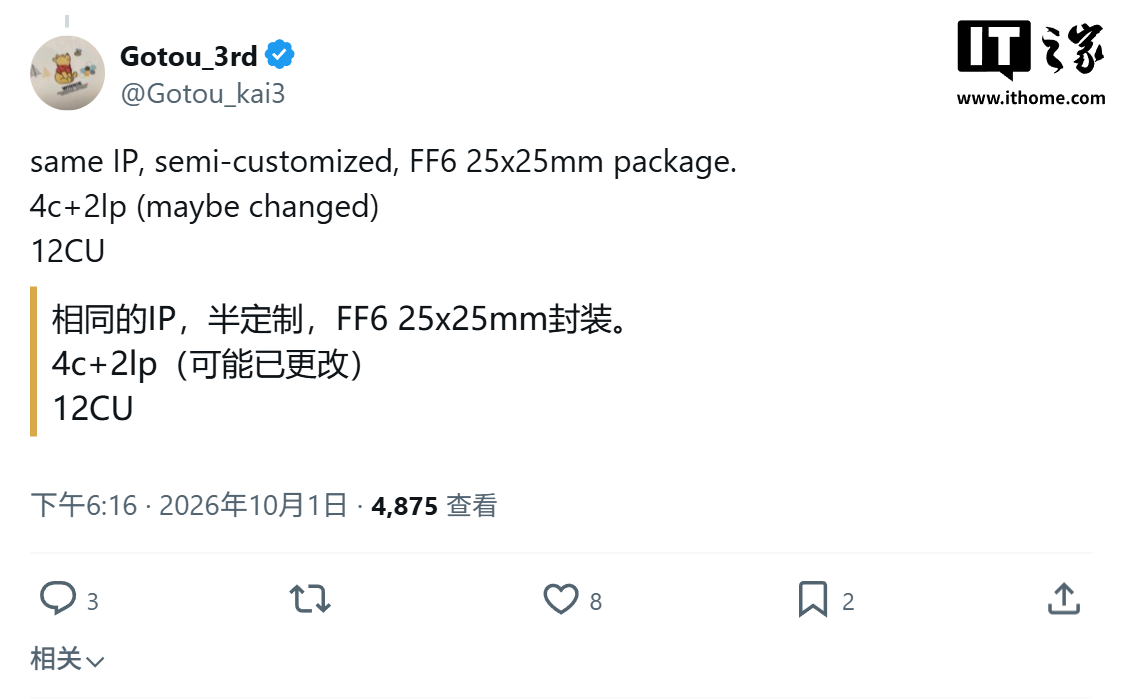
The Ryzen Z3 series is expected to be based on the ‘Medusa Point’ architecture. A key highlight is its hybrid CPU design, which combines Zen 6 cores with lower-power Zen 5 (Zen 5 LP) cores. Early estimates suggest a configuration of 4 Zen 6 cores and 2 Zen 5 LP cores, totaling 6 cores and 12 threads. AMD may, however, adjust these specifications before the final product launch.
Enhanced GPU Performance
In a move to bolster graphical capabilities, the Ryzen Z3 series is reportedly set to feature 12 Compute Units (CUs) based on the RDNA 4m architecture. This configuration is more substantial than the typical 8 CU setup found in standard Medusa Point designs. To accommodate this larger GPU configuration, AMD appears to have reduced the number of Zen 6c CPU cores, dedicating more silicon area and power budget to the graphics processing unit.
RDNA 4m Graphics
While not upgrading to RDNA 5, the Ryzen Z3 series will leverage RDNA 4m, an evolution of the RDNA 3.5 architecture. A significant addition to RDNA 4m is the inclusion of RDNA 4-level ALUs designed for matrix operations. This enhancement is expected to provide native support for emerging technologies such as FSR 4 (FidelityFX Super Resolution 4) and potentially enable future advanced features.
Power Consumption and Positioning
The upcoming chips are being optimized for different power envelopes. The standard Ryzen Z3 is targeted for a power consumption of around 15W, making it suitable for efficient, longer-lasting gaming sessions. For users seeking higher performance, the Ryzen Z3 Extreme variant is aimed at a power target of approximately 25W, allowing for more demanding gaming experiences.
Packaging and Design
Another notable detail is the chip’s packaging. The Ryzen Z3 series is said to utilize a 25×25 mm FF6 package. This is smaller than the FP8 package used for the ‘Strix Point’ chips, suggesting a more compact and potentially more power-efficient design for the new generation of handhelds.
The emergence of these details paints an exciting picture for the future of handheld gaming. With a focus on hybrid CPU architectures, enhanced RDNA 4m graphics, and optimized power consumption, AMD’s Ryzen Z3 series appears poised to deliver a significant leap in performance and capabilities for gamers on the go.