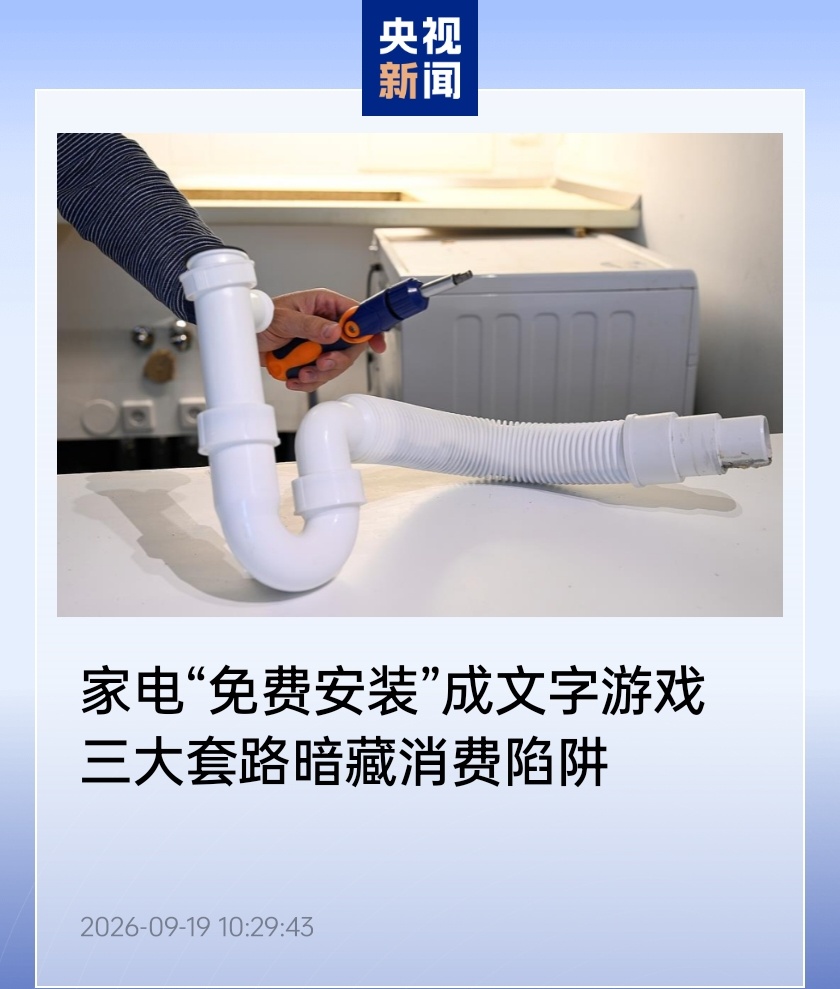
The promise of “free installation” for home appliances often turns into a misleading marketing tactic, with consumers frequently facing unexpected charges for essential materials and complex installation scenarios. China’s Consumer Association is now shedding light on the common pitfalls and deceptive practices prevalent in the industry.
The Illusion of Free Installation
While advertised as complimentary, the “free installation” often covers only basic labor. Consumers are frequently hit with additional fees for necessary components like piping, valves, and gas lines, sometimes amounting to a significant portion of the appliance’s total cost. In one instance reported by CCTV, a consumer in Taiyuan, Shanxi, was charged over 500 yuan for consumables for a gas water heater, despite the advertised free installation. The appliance itself cost 3,000 yuan, making the installation materials a substantial extra expense.
Another consumer in Hohhot, Inner Mongolia, who purchased several home appliances for a new apartment, found that while some items like a steam-roast oven didn’t require extra parts and a robot vacuum benefited from an existing water system, other appliances incurred consumable fees upon installation. The sales representatives, according to the consumer, did not disclose these potential additional charges during the initial purchase.
Common Deceptive Practices Unveiled
Li Qian, a staff member at the Shandong Provincial Consumer Association, identified three primary deceptive tactics:
- Shrinking Scope: Basic labor is free, but the costs for auxiliary materials and special installation conditions are not disclosed upfront. In some cases, high-priced accessories are pushed onto consumers under the guise of maintaining the product’s warranty.
- Wordplay:收费条款 are ambiguously stated in small print or in obscure sections of promotional materials, leading to a lack of transparency.
- “No-Show” Fees: Consumers are charged for “empty trip” fees or “site survey” fees only when installation cannot proceed as planned, without prior notification, infringing on the consumer’s right to know.
The association noted that issues are particularly common with air conditioners, water heaters, range hoods, and stoves due to their complex installation processes, numerous required materials, and varied site conditions. Similar problems also arise with water purifiers, built-in appliances, and large-screen televisions.
Navigating the Pitfalls and Seeking Redress
Consumers encountering unexpected charges are advised to immediately contact the company’s official customer service to verify the necessity and standard of the fees. They should not solely rely on the installer’s verbal explanations. If direct negotiation with the seller fails, consumers can seek assistance through official channels, including the 12345 hotline, the National Consumer Association’s Smart 315 platform, or local consumer protection associations.
For cases of malicious fraud, legal action may be necessary. A crucial aspect of effective consumer protection is maintaining a complete chain of evidence, including merchant promotional materials, communication records, payment receipts, on-site photographs, and records of prior cost confirmations.
Addressing Industry-Wide Issues
The Consumer Association pointed to the widespread outsourcing of appliance installation services as a contributing factor to the “random charging” phenomenon. Additionally, some companies prioritize sales over after-sales service and lack robust third-party assessment mechanisms.
To tackle these issues, the association proposes two key recommendations:
- Strengthen Corporate Responsibility: Companies should uniformly publicize installation fee standards, detailed lists of auxiliary materials, and charges for special conditions. A mechanism for vetting third-party service providers, including a blacklist system for non-compliant ones, needs to be established.
- Standardize Service Procedures: Implement a transparent process that includes upfront quoting, transparent execution throughout the service, and traceability after completion.
Moving forward, the Consumer Association plans to issue risk warnings, analyze cases, and collaborate with relevant authorities to push for improvements in industry standards and fee disclosure regulations for home appliance installation services.