The Five-hundred-meter Aperture Spherical radio Telescope (FAST), often referred to as “China Sky Eye,” has achieved a significant milestone in astronomical research. The FAST Neutral Hydrogen (FASHI) project, led by researcher Jiang Peng’s team at the National Astronomical Observatories of the Chinese Academy of Sciences, has released its second data release (FASHI DR2). This release establishes the world’s largest sample library of galaxies based on neutral hydrogen, marking a pivotal moment for astronomical observation and cosmology.
FAST DR2 Doubles Previous Discoveries
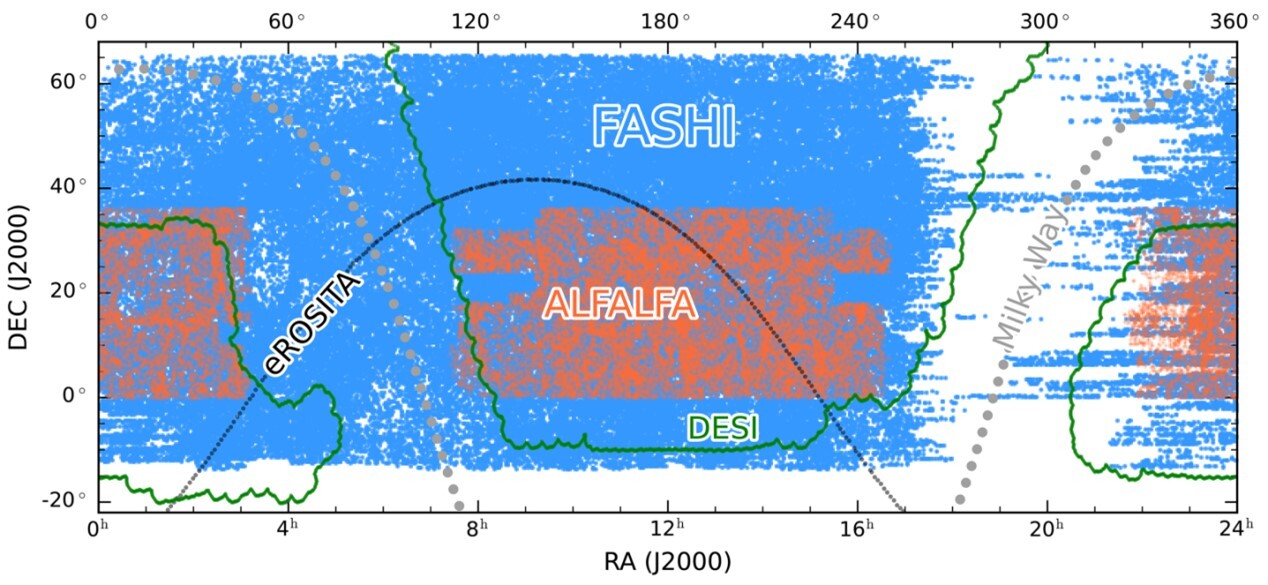
In its two-year observation period, FASHI DR2 has detected an impressive 156,411 extragalactic neutral hydrogen sources. This number represents a nearly fourfold increase compared to the 41,741 sources identified in the first data release. The survey’s coverage area has also dramatically expanded, from 7,600 square degrees to 19,500 square degrees, encompassing 47.3% of the entire sky. This extensive reach is more than five times the number of sources accumulated by the US Arecibo telescope’s ALFALFA survey over more than a decade, which covered approximately 7,000 square degrees and identified around 31,500 sources. FAST has now set a new benchmark twice within two years.
Understanding Neutral Hydrogen’s Significance
Neutral hydrogen is a fundamental component of the universe, serving as the raw material for star formation and the building blocks of galaxies. Its characteristic 21-centimeter radiation can penetrate interstellar dust, carrying crucial information about gas in the deepest parts of the cosmos. By studying neutral hydrogen, astronomers can gain invaluable insights into the formation and evolution of galaxies and the large-scale structure of the universe.
Enhanced Sensitivity and Resolution
FASHI DR2 boasts a typical sensitivity of 0.57 mJy/beam and a velocity resolution of 6.4 km/s. This represents an improvement of approximately 0.7 times over the ALFALFA survey, making it significantly deeper and more detailed. International peer reviewers have lauded the dataset as a “long-awaited, milestone dataset for the astronomical community.” This data growth is attributed to the exceptional sensitivity and stability maintained by FAST during its five-year observation cycle, which runs from August 2020 to July 2025. The synergy between the 19-beam receiver and the drift scanning strategy has enabled breakthroughs in both survey depth and breadth.
New Frontiers in Galaxy Evolution Research
Leveraging the FASHI DR2 data, the research team has extended the reliable measurement range of the neutral hydrogen mass function to approximately one million times the mass of the Sun for the first time. Furthermore, the statistical accuracy of the neutral hydrogen density in the local universe has reached 0.6%, representing the most precise measurement of this physical quantity to date. These advancements are expected to significantly impact research in areas such as galaxy evolution, cosmology, large-scale structure, the localization of host galaxies for gravitational wave events, and preparatory studies for the Square Kilometre Array (SKA) era.
Data Accessibility and Future Impact
The FASHI DR2 source catalog is now publicly available to the global scientific community. Researchers can access the data through the official FAST website: https://fast.bao.ac.cn/cms/article/271/.
The groundbreaking findings associated with this dataset have been published as a cover story in Science China Physics, Mechanics & Astronomy. The paper can be accessed at: https://doi.org/10.1007/s11433-026-3072-1.
The FAST telescope’s continuous contributions are paving the way for deeper understanding of the universe, from its earliest moments to the formation of complex galactic structures.