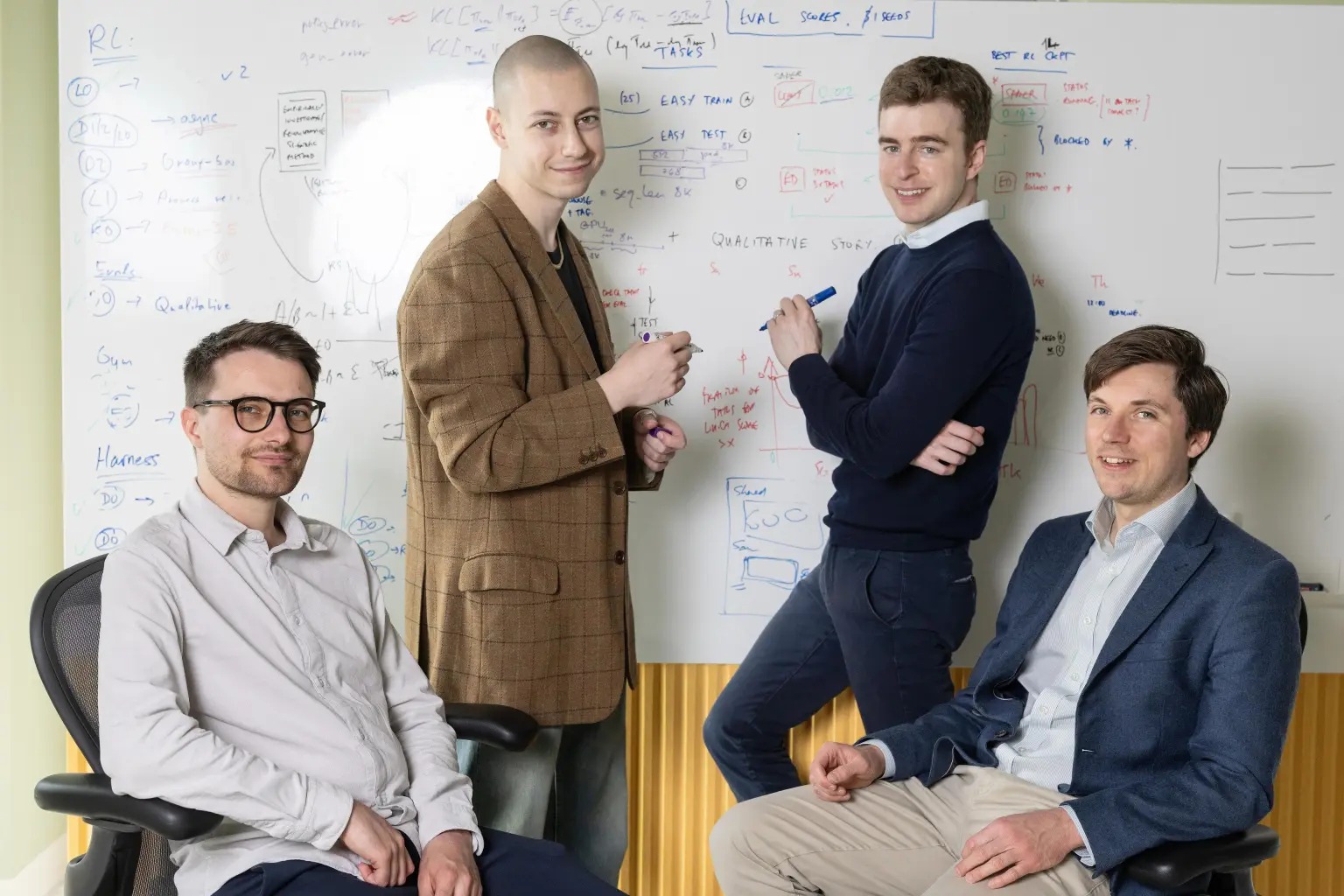
London-based AI startup Inherent, founded by former Google DeepMind employees, has unveiled its new AI agent, Faraday. In a specific scientific replication task, Faraday demonstrated superior performance compared to larger, more established models like Anthropic’s Claude Opus 4.8 and OpenAI’s GPT-5.5, despite utilizing a significantly smaller model with only 27 billion parameters (Qwen 3.6).
Faraday’s Breakthrough in Scientific Replication
Inherent’s Faraday agent has achieved a remarkable feat: autonomously replicating research findings from published scientific papers without prior knowledge of the answers. This capability is particularly noteworthy as it surpasses the performance of leading AI models that operate with vastly larger parameter counts. The ability to accurately reproduce scientific results is a foundational skill, often serving as a training ground for human scientists, akin to the early stages of a PhD.
Edward Hughes, co-founder and chief scientist at Inherent, emphasized that the primary significance lies not merely in outperforming other AI systems, but in the innovative methodology employed by Inherent. “What’s most interesting to us isn’t necessarily the outcome of beating those leading agents – though we’re pleased with that – but rather the way we’ve constructed this system,” Hughes stated.
The Power of a Smaller, Smarter Model
The comparison with Claude Opus 4.8 and GPT-5.5 highlights a key differentiator: Faraday’s efficacy stems from a substantially smaller model architecture. While ‘parameters’ serve as a common metric for AI model size and often correlate with training costs, Inherent’s approach suggests that efficiency and architectural design can yield competitive or superior results.
Beyond mere accuracy in replication, Inherent aims for Faraday to possess ‘research taste’ – the capacity to discern which experiments are scientifically valuable and how to design them effectively. Cultivating this less quantifiable attribute is where reinforcement learning plays a crucial role. Instead of explicit rule-based instruction, Inherent utilizes a reward-based system that guides the AI towards more effective actions and decisions over time. This method is intended to facilitate better generalization towards the long-term goal of AI agents capable of conducting research across multiple scientific domains.
“We’ve always had this North Star goal of building AI scientist agents, giving them research taste.” – Edward Hughes
Strategic Development and Collaboration
Inherent’s philosophy extends to its product development strategy. Rather than building all necessary tools internally, Faraday leverages existing resources, such as OpenAI’s GPT-5.5 Codex for programming tasks. This mirrors the collaborative approach of human scientists who utilize a range of established software and tools.
The company also strives to avoid creating AI agents that merely appease users or confirm pre-existing beliefs. Hughes likens the desired AI behavior to that of a valuable teammate who proactively conducts experiments and seeks constructive feedback on the findings. This collaborative spirit is reflected in the company’s operational structure, with its approximately 12 employees working together in a physical office in London’s King’s Cross district.
London as an AI Hub and Future Growth
King’s Cross has evolved into a significant hub for AI innovation, partly due to the presence of Google DeepMind. Hughes expressed strong confidence in London as an ideal location for AI development, citing the high concentration of talent.
However, Hughes also voiced support for reconsidering the UK’s ‘garden leave’ policy, which restricts departing employees from joining competitors or starting rival ventures for a period. He noted that such restrictions can disadvantage UK startups compared to their US counterparts, where similar limitations are less common. Hughes himself encountered obstacles due to garden leave but found ways to establish Inherent with three other former DeepMind colleagues.
Inherent is poised for further expansion, planning to grow its team to between 20 and 25 employees by the end of the year. With uncertainty surrounding the future roles of some DeepMind employees following Demis Hassabis’s new position and Inherent’s focus on world models, the startup presents a potentially attractive destination for AI talent seeking new opportunities.