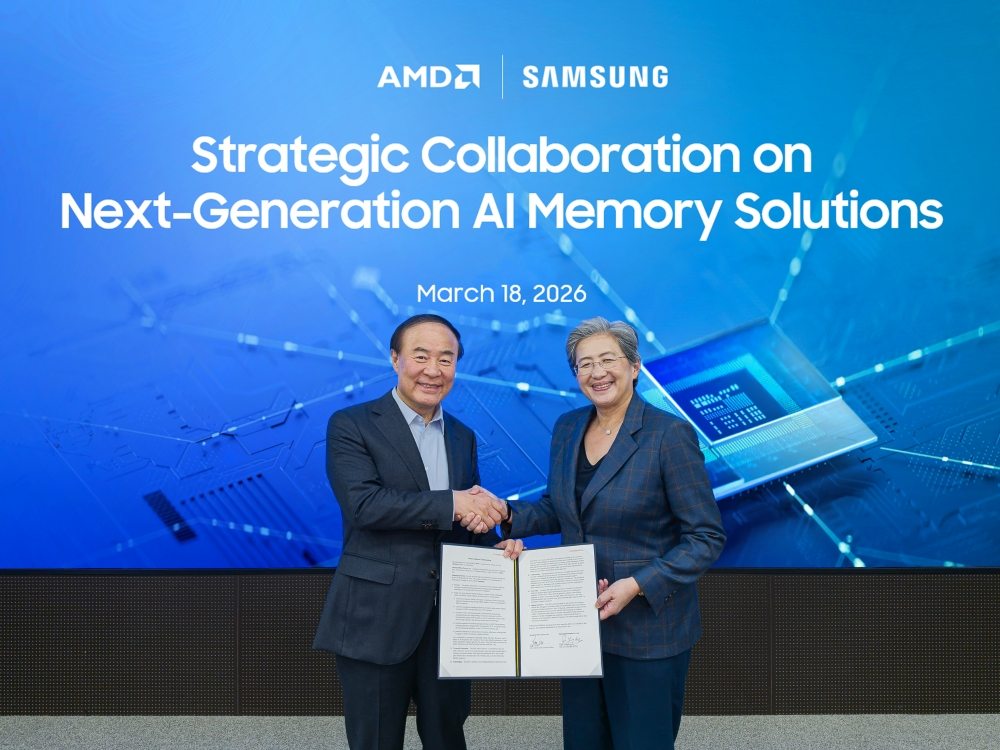
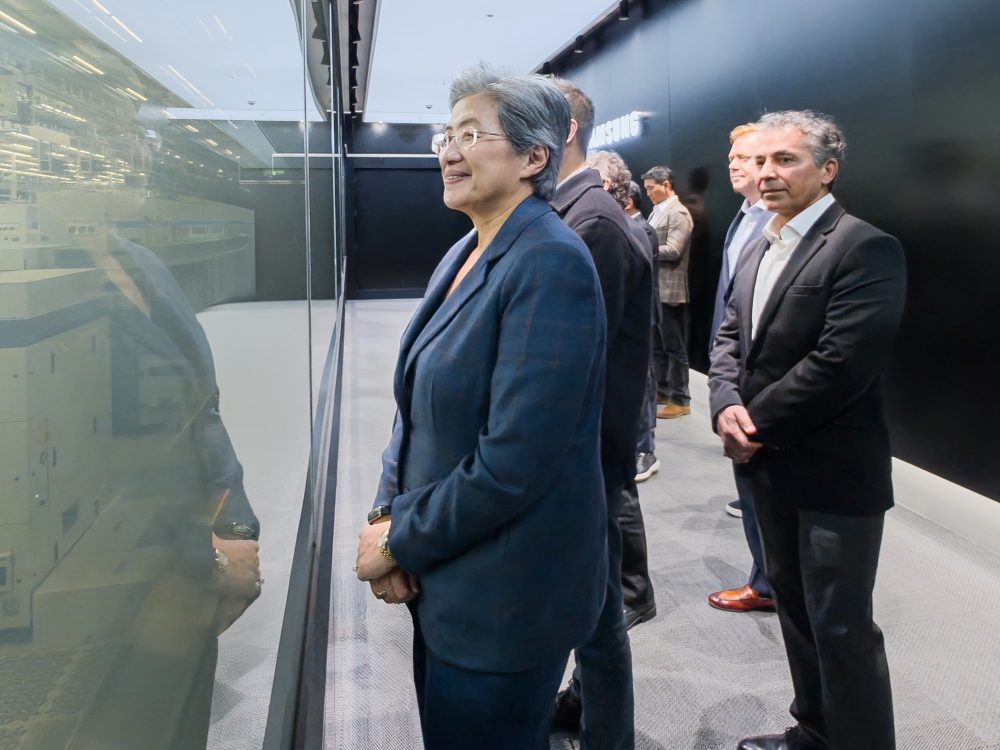
In a move that reshapes the semiconductor landscape, Dr. Lisa Su (CEO of AMD) and Young Hyun Jun (CEO of Samsung) met today at the Pyeongtaek mega-fab to sign a strategic collaboration agreement. This partnership is designed to fuel the next generation of AI “Gigafactories” by integrating Samsung’s world-first HBM4 memory with AMD’s upcoming Instinct MI455X GPUs.
The HBM4 Breakthrough: 3.3 TB/s Bandwidth
Samsung has achieved an industry first with its 6th-generation 10nm-class DRAM (1c). This isn’t just a minor update; it’s a generational leap in memory performance.
-
Speed: 13 Gbps per pin.
-
Throughput: A staggering 3.3 Terabytes per second (TB/s) bandwidth.
-
Logic Die: Built on a 4nm process, allowing for unprecedented energy efficiency in AI training.
AMD’s Roadmap: Instinct MI455X and “Venice” EPYC
This memory isn’t just sitting in a lab—it has a clear destination:
-
AMD Instinct MI455X GPU: This next-gen accelerator will be the first to utilize Samsung’s HBM4, targeting the “sweet spot” of high-performance AI model training and real-time inference.
-
6th Gen AMD EPYC “Venice”: Samsung will be the primary provider of optimized DDR5 memory for these CPUs, which are the backbone of the new AMD Helios rack-scale platform.
-
The Helios Platform: AMD’s answer to NVIDIA’s GB200 NVL72. Helios is a full-rack architecture designed for “Planetary Scale” AI clusters.
Comparison: The AI Memory Evolution (2024 vs 2026)
| Feature | HBM3E (2024 Standard) | Samsung HBM4 (2026 Standard) |
| Max Bandwidth | ~1.2 TB/s | 3.3 TB/s |
| DRAM Process | 1a / 1b nm | 1c (6th Gen 10nm-class) |
| Logic Die | 5nm / 7nm | 4nm |
| Primary GPU | MI350X / H100 | Instinct MI455X |
| Target Architecture | Dense Clusters | AMD Helios Rack-Scale |
The Strategic “Turnkey” Advantage
Perhaps the most interesting part of the MOU is the discussion of Foundry Partnership. Samsung is positioning itself as a “turnkey” solution provider. This means AMD could potentially move beyond just buying memory and actually use Samsung’s foundries to manufacture the next generation of AMD chips, further diversifying away from TSMC.
Impact on Global AI Scaling
For the Agentic State and the industrial AI goals discussed by Lenovo earlier, this partnership ensures that the “data hunger” of 2026 models is satisfied. With 3.3 TB/s bandwidth, the I/O Bottleneck mentioned in the OCI MSA analysis is finally being dismantled at the silicon level.