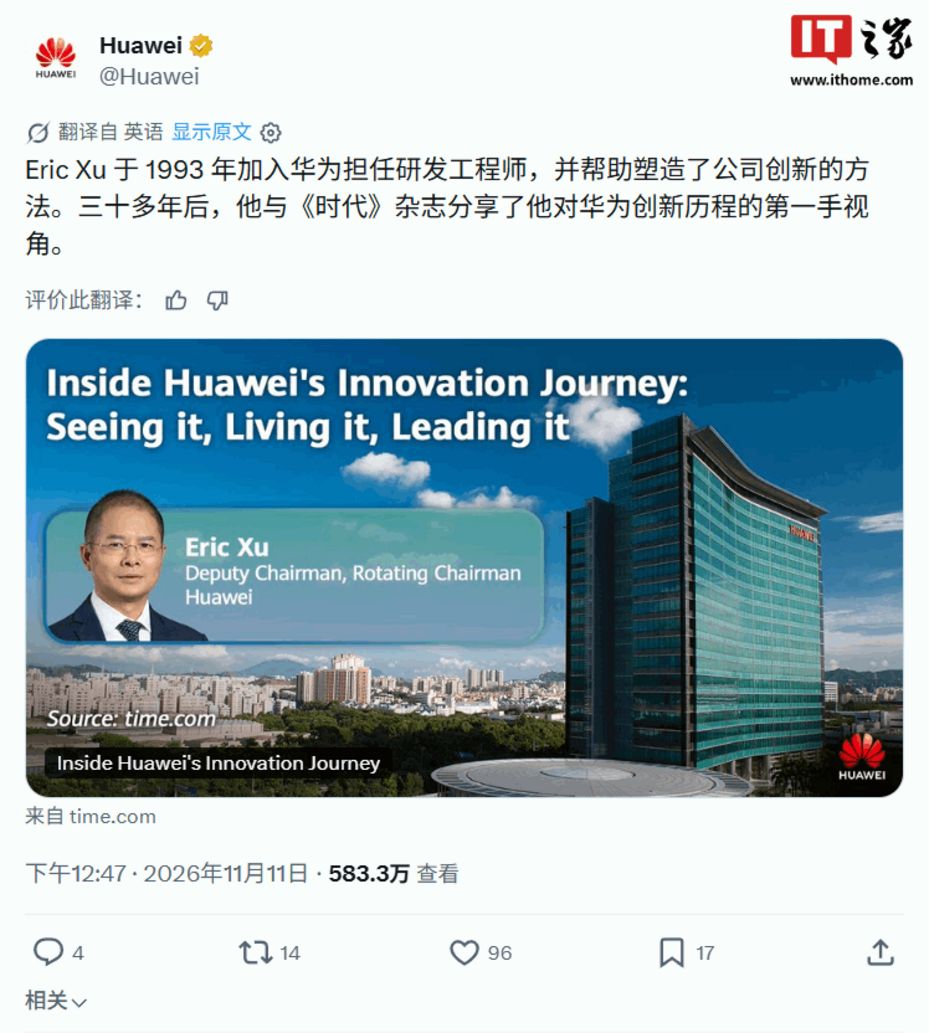
In a candid reflection shared on Huawei’s official X account, Vice Chairman and rotating Chairman Eric Xu (Xu Jijun) offers an intimate look into the company’s formative years. His article, published in TIME magazine and titled “Inside Huawei’s innovation journey: Seeing it, living it, leading it,” details Huawei’s more than three decades of innovation from a first-person perspective.
Xu recalls joining Huawei in 1993 when the company’s R&D team was intensely focused on developing digital program-controlled switches. At the time, China’s economy was booming, and the demand for both home and office landlines far outstripped supply. For many years, installing a phone was a difficult and expensive undertaking. While Western manufacturers had already entered the Chinese market, their incompatible standards and high costs – approximately 3,000 RMB per line, a significant sum then – presented a substantial barrier.
This situation, however, created a unique market opportunity. Xu explains that with numerous towns and villages surrounding major cities, establishing a full-fledged exchange system for each small location was economically unfeasible. Furthermore, using copper cables to connect remote areas was not only costly but also prone to signal degradation.
Huawei’s innovative solution was the development of a remote optical fiber exchange module. This technology allowed a single central system to provide network coverage for an entire county. Xu emphasizes that this product was met with strong approval from customers.
“This is how Huawei rapidly expanded its business through direct competition with established Western telecommunications vendors,” Xu writes, noting that these Western firms had, without exception, formed joint ventures with Huawei’s clients.
Huawei’s product offered a dramatically lower cost per line, around 1,000 RMB, while still maintaining a gross profit margin exceeding 20%. This financial success was instrumental in fueling Huawei’s rapid growth and providing much-needed cash flow for further development.
Xu also provides striking figures illustrating the company’s growth trajectory during that pivotal decade. Between 1993 and 2002, Huawei’s workforce swelled from approximately 600 employees to 22,000. Within this expanding team, the number of R&D engineers grew to over 10,000. Concurrently, the company’s revenue surged to nearly 4 billion USD (approximately 26.714 billion RMB at current exchange rates).
Xu himself joined Huawei in 1993 when the company had about 600 employees, with over 200 of them in R&D, including a significant number of postgraduate students. He also notes that five PhD holders joined the company the same year he did, highlighting Huawei’s early commitment to attracting top talent and investing heavily in research and development.
The article serves as a compelling testament to Huawei’s early strategic vision, its ability to innovate under competitive pressure, and the foundational role that cost-effective, high-quality solutions played in its ascent within the global telecommunications industry.