Huawei has continued its deep dive into the architecture of its upcoming Kirin 9050 series chipset, the first to feature its innovative “logical folding” technology. Following previous revelations about the CPU and NPU, the company has now unveiled exciting details regarding the new generation Mali GPU and the Kirin AI ISP (Image Signal Processor).
Next-Generation Mali GPU: Power and Efficiency Boost
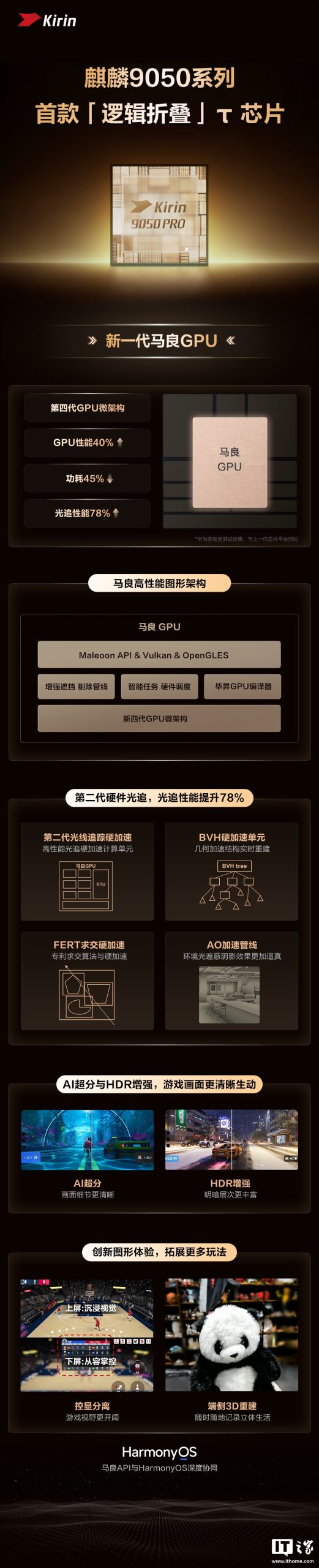
The Kirin 9050 series is set to integrate a new generation of Mali GPU, promising significant upgrades in performance, power efficiency, and overall graphics experience. According to Huawei, this new GPU utilizes a fourth-generation micro-architecture, resulting in a notable 40% increase in GPU performance while simultaneously decreasing power consumption by 45%.
A standout feature is the inclusion of second-generation hardware ray tracing support. This enhancement offers a substantial 78% improvement in ray tracing performance. The GPU is equipped with high-performance ray tracing hardware acceleration compute units, a BVH (Bounding Volume Hierarchy) hardware acceleration unit for real-time reconstruction of geometric acceleration structures, and FERT intersection hardware acceleration that supports patented intersection algorithms. Additionally, an AO (Ambient Occlusion) acceleration pipeline is incorporated to deliver more realistic ambient occlusion shadow effects.
Beyond ray tracing, the Kirin 9050 series GPU also supports AI Super Resolution and HDR enhancement technologies. These features are designed to render clearer image details and richer contrast between light and dark areas. The GPU capabilities extend to functionalities like display-control separation and on-device 3D reconstruction. Huawei also highlighted that the Mali API is engineered for deep synergy with the HarmonyOS operating system.
Kirin AI ISP: Revolutionizing Mobile Photography
The newly revealed Kirin AI ISP for the 9050 series is equally impressive. It integrates a dedicated NPU for pixel processing alongside the general-purpose NPU, operating in a dual-engine configuration. This powerful combination enables real-time 4K 60fps video processing and, for the first time, achieves fused photography with a staggering 200 million high-pixel count.
Further enhancing the imaging capabilities, the chipset supports 18EV high dynamic range video recording, a telephoto ultra-clear engine for sharper long-range shots, pixel-level portrait optimization, and full-link BT.2020 wide color gamut support. These advancements collectively aim to elevate both the still photography and video recording experience for users.
These revelations follow previous announcements detailing the Kirin 9050 series’ new generation Lingxi CPU with its 9-core, 16-thread parallel scheduling and memory compression acceleration, as well as its new generation DaVinci architecture NPU, which notably incorporates the industry’s first 30B MoE large model for on-device deployment. The company previously detailed core upgrades, including a 53.5% surge in transistor density attributed to the “logical folding” technology.
With these detailed specifications for the GPU, AI ISP, CPU, and NPU, the Huawei Kirin 9050 series chipset appears poised to set new benchmarks in mobile processing power, graphics rendering, and computational photography.