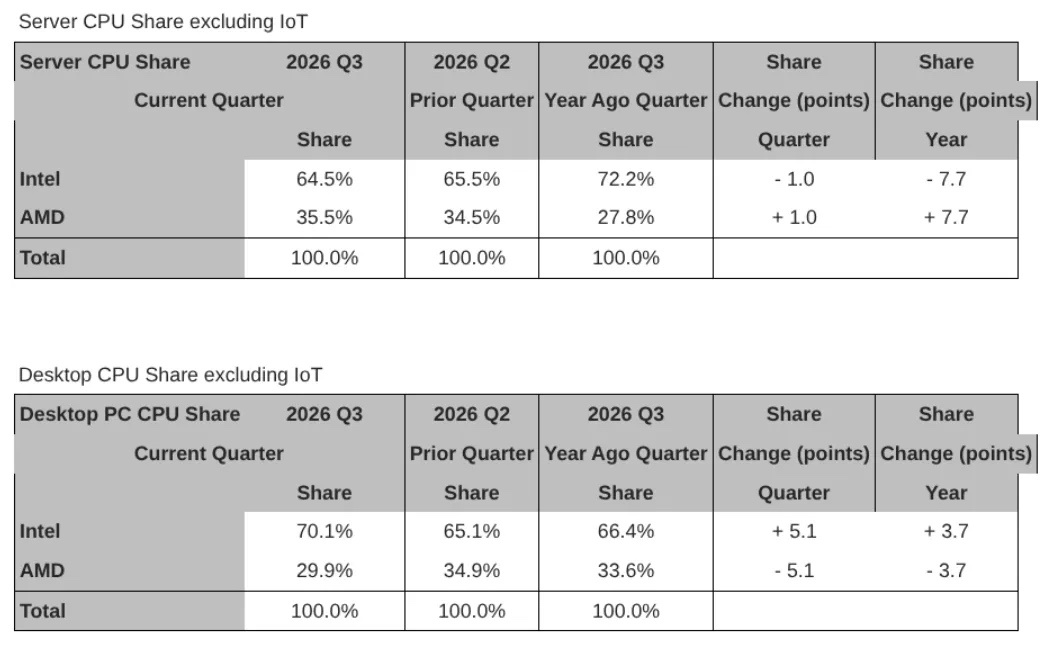
According to the latest data from Mercury Research, AMD’s market share for desktop CPUs saw a significant decline in the third quarter of 2026. The company’s share dropped to 29.9%, a five-percentage-point decrease from the 34.9% recorded in the second quarter. This marks the lowest desktop share for AMD since the beginning of 2025, when it stood at approximately 28%.
Conversely, Intel experienced a notable rebound, regaining market share to reach 70.1% in the desktop CPU segment. While the exact reasons for Intel’s substantial fluctuation remain unclear, Mercury Research offers a leading hypothesis. The firm suggests that due to weakened demand in the laptop market, Intel was able to redirect more of its chip production capacity towards the desktop sector.
This strategic shift by Intel appears to have coincided with the typical seasonal increase in desktop market demand during the third quarter. Meanwhile, AMD seemingly did not benefit from this seasonal surge. Mercury Research points out that AMD’s business is more heavily reliant on the PC gaming market, a sector currently hampered by limited graphics card supply.
Furthermore, AMD has openly acknowledged that current demand is outstripping its supply capabilities. CEO Lisa Su has recently emphasized that AMD operates with a “data center first” strategy, which may indicate a prioritization of resources towards their server offerings.
The situation in the server market presents a stark contrast to the desktop segment. In the server arena, AMD’s market share continued its upward trajectory, climbing from 34.5% in the previous quarter to 35.5%. This growth in the server space highlights AMD’s strategic focus and success in a different, yet crucial, segment of the computing industry.
This shift in desktop market share could have significant implications for both AMD and Intel as they navigate the evolving landscape of the PC hardware industry. While Intel reclaims dominance in the traditional desktop space, AMD’s strategic focus on data centers and its challenges in the gaming-dependent PC market will be key factors to watch in the coming quarters.