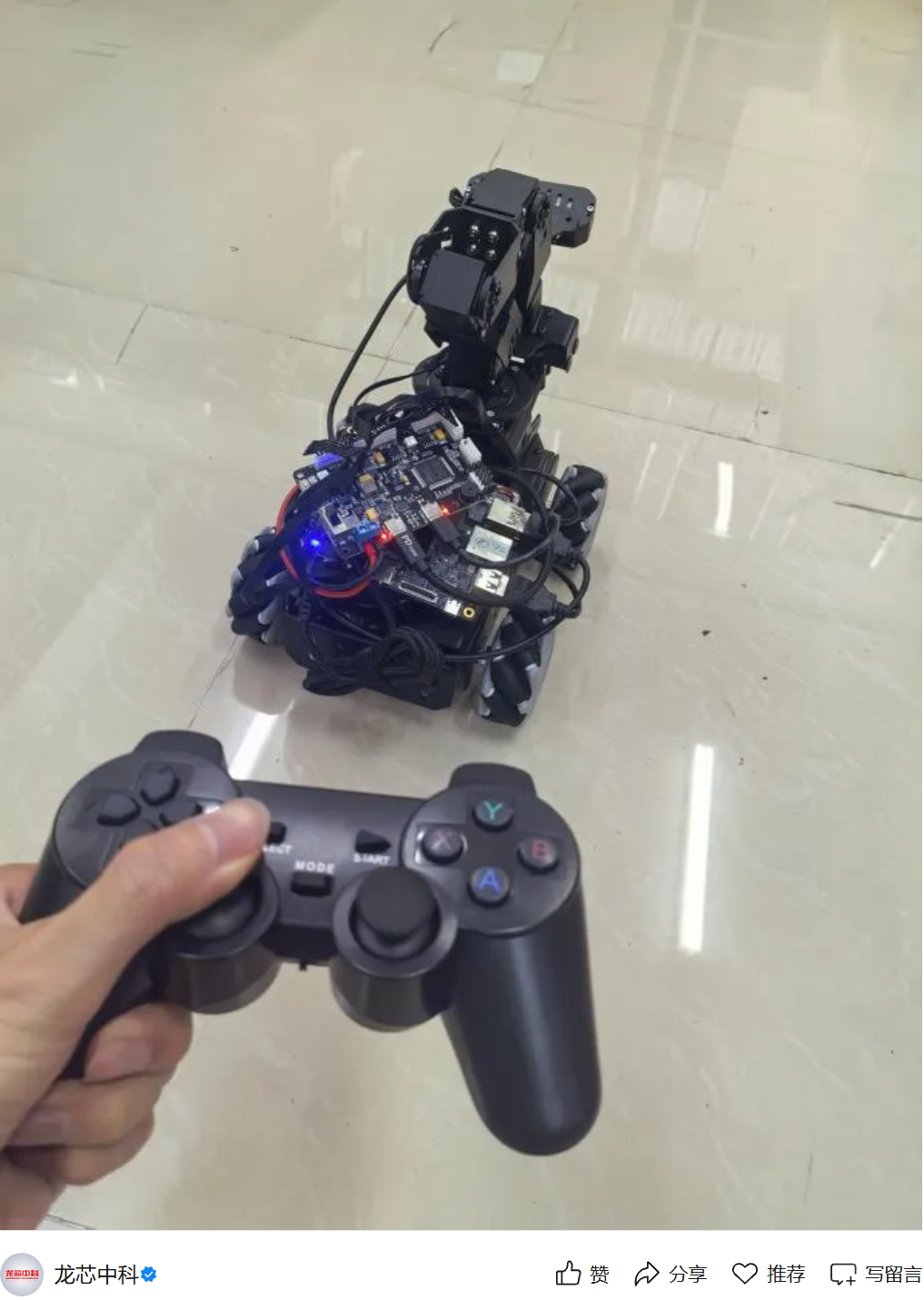
Loongson Zhongke has announced a significant milestone in domestic robotics development, successfully completing the full-stack porting of the ROS2 Jazzy version onto their self-developed intelligent robot platform. This achievement integrates a comprehensive workflow, encompassing environment mapping and positioning, joystick control, robotic arm manipulation, and depth vision capabilities, all orchestrated by the Loongson 2K3000 processor. The intelligent robot is now equipped to perceive its surroundings and perform object grasping tasks.
ROS2 and the Rise of Domestic Robotics
ROS2, or Robot Operating System 2, is a widely adopted open-source middleware framework within the robotics community. Its strengths lie in its cross-platform compatibility and distributed communication features, which enable the creation of reusable networks connecting sensors, algorithms, and actuators. The successful full-stack porting by Loongson Zhongke not only demonstrates the capability of their hardware but also establishes a reusable, domestically developed solution for robot development.
The Powerhouse: Loongson 2K3000 Processor
At the heart of this intelligent robot is the Loongson 2K3000 processor. Manufactured using a 12nm process, this chip integrates eight LA364E processor cores based on Loongson’s proprietary Dragon architecture. These cores operate at a clock speed of up to 2.5GHz. The processor features a cache configuration of 64KB for both instruction and data caches, coupled with a shared 6MB of L2 cache. Loongson reports that the single-core performance of the 2K3000 is comparable to ARM Cortex-A76 level processors, with a measured SPEC CPU 2006 Base single-core integer score reaching 30 points.
Perception and Control: A Multi-faceted Approach
The robot’s perception system is designed with a dual-link approach. Environmental sensing in the plane is handled by a LiDAR unit mounted on the robot’s body. For three-dimensional depth perception, a depth camera is integrated at the end of the robotic arm. Loongson has meticulously calibrated these systems for indoor environments, complementing them with odometry data to enhance positioning stability and the completeness of environmental mapping.
In terms of locomotion, the robot utilizes Mecanum wheels. By precisely controlling the rotational speeds of four independent motors, the robot achieves omnidirectional movement, enabling forward, backward, lateral, rotational, and diagonal motions. User interaction is facilitated through a USB joystick connected directly to the main control board. Loongson’s proprietary software translates joystick inputs into velocity commands, incorporating dead-zone filtering and a safety enable button for precise and safe control.
Future Directions and Applications
Looking ahead, Loongson plans to implement emergency stop functionalities and watchdog timers. Additionally, they aim to integrate motion groups into upper-level programs and advance the capabilities for 3D object localization through the fusion of detection and point cloud data. The successful validation of the complete workflow, from mapping and positioning to robotic arm grasping, underscores the viability of the Loongson 2K3000 processor for complex robotic computations and real-time control. This development offers a valuable reference solution for prototyping in areas such as industrial automation and intelligent warehousing.