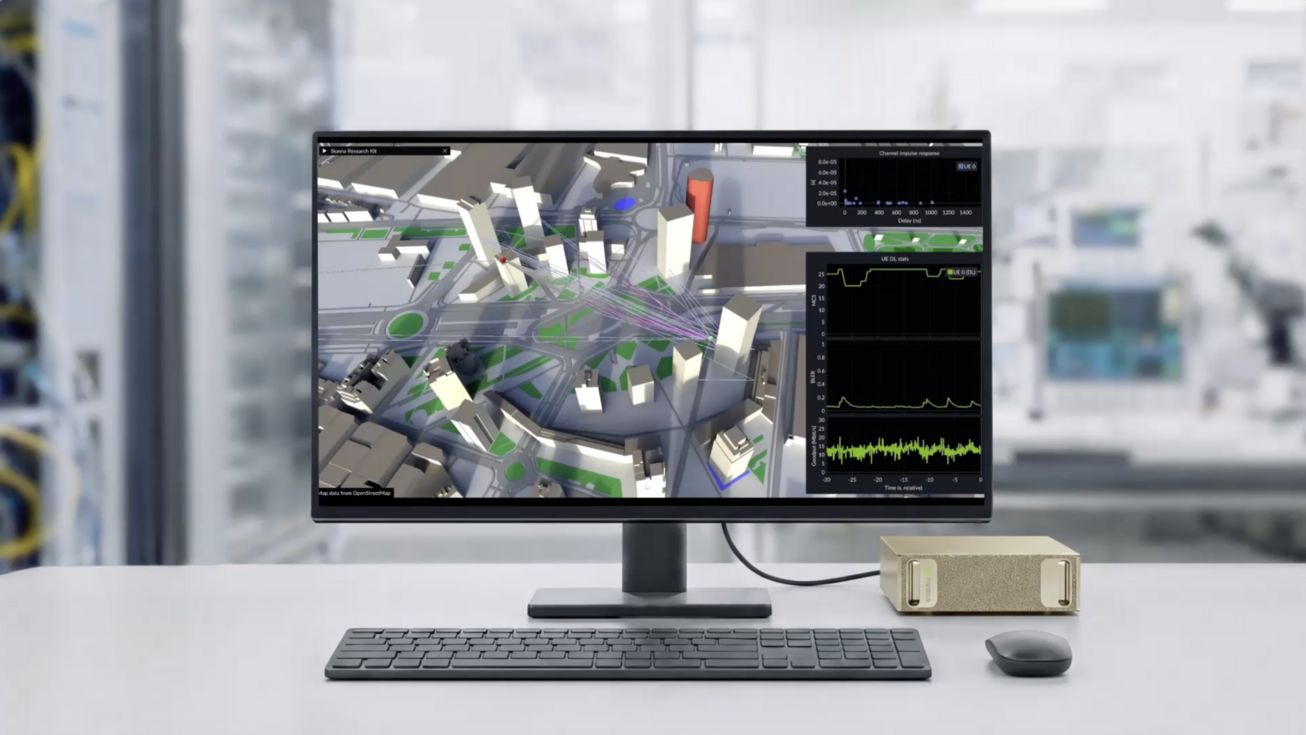
NVIDIA is empowering researchers and developers working on the next generation of wireless communication with a suite of open-source tools. Building on the company’s existing Aerial wireless software, NVIDIA has expanded its offerings to include Sionna and a broader set of open-source resources designed to expedite the development of 6G networks. These solutions aim to provide a robust foundation for testing new ideas, comparing results, and fostering collaboration by merging simulation, AI training, and real-world wireless system experimentation.
The adoption of NVIDIA’s AI Aerial and Sionna tools has seen a tenfold increase over the past year, with NVIDIA’s open-source 5G/6G tools surpassing one million downloads. These platforms are now utilized by over 8,000 research and academic institutions globally, signaling a growing interest in developing advanced wireless networks capable of more than just data transmission. The focus is on enabling more efficient signal reception, ensuring reliable connectivity for critical robotic and autonomous systems, and facilitating real-time adaptation to device mobility.
Networks Enabling Faster Robot Response
Robots performing tasks like object retrieval require an immediate understanding of their environment and the ability to act before conditions change. When the AI controlling these robots operates remotely, the latency of the wireless connection becomes a critical factor. Researchers are exploring a more efficient approach known as targeted semantic communication. Instead of transmitting full video feeds, robots send compressed descriptions of objects, their positions, and relationships. This targeted data transfer allows robots to respond more quickly, particularly in dynamic settings such as factory floors and warehouses.
At King’s College London, researchers integrated a robotic arm with a camera into an NVIDIA Jetson AGX Orin. Utilizing NVIDIA Sionna, which supports software-defined 5G networks and edge AI processing, their experiments in fruit packing and cube assembly demonstrated significant improvements. Even with intentionally introduced disruptions, this method reduced task completion time by up to 52.6% and enhanced success rates compared to transmitting periodic images. The system also showed greater resilience, detecting dropped objects, recovering from failed actions, and, in digital twin configurations, verifying planned movements for potential collisions before execution.
Networks Learning to Improve Signal Reception
For situations like a firefighter receiving drone imagery or a rescue team searching for a missing person, timely visual information is crucial for making urgent decisions. However, interference and fluctuating radio conditions can make decoding wireless signals difficult, leading to errors and retransmissions that delay vital information from the scene. AI-powered receivers are addressing this challenge by learning to more effectively reconstruct information from incoming signals. Improved reception can help emergency responders maintain a clearer, more up-to-date situational awareness.
SoftBank showcased this by integrating a neural receiver into NVIDIA Aerial CUDA-Accelerated RAN (ACAR) and testing it with a commercial 5G smartphone. In controlled tests with interference, the neural receiver achieved higher uplink throughput compared to a conventional receiver across all 15 tested configurations, with a maximum improvement of approximately 60%. Another method for enhancing reception involves training receivers to operate in specific environments. Researchers at ETH Zurich, using NVIDIA Aerial Testbed, found that fine-tuning neural receivers with local measurements reduced the block error rate by over a third compared to pre-trained versions.
Networks Learning to Conserve Energy
As 6G expands to connect more devices and support AI applications, energy management will become increasingly critical. For instance, a network might need substantial power to serve a packed stadium, but demand drops significantly when the crowd disperses. AI can help identify when surplus power can be turned off and when it needs to be reactivated, allowing operators to reduce electricity consumption without sacrificing connectivity.
Researchers at the University of Leeds have developed a system that forecasts network demand up to 10 minutes in advance, using these predictions to decide when to put base stations into a sleep mode. Before shutting down, the system verifies that neighboring active stations can continue serving affected devices and monitors for changes that require power restoration. The team tested their approach using a portable all-in-one 5G network based on NVIDIA DGX Spark, along with a digital twin to validate decisions on real wireless equipment. The result: researchers reported a 45.6% reduction in RAN energy consumption compared to operating at full power, while maintaining device connectivity.
Networks That Can Be Tested Faster – Before They’re Built
Before deploying a network, researchers need to understand how it will perform when hundreds of devices compete for connectivity or when radio signals encounter obstructions. Simulating these conditions helps teams evaluate designs before investing in costly hardware and field trials. However, realistic simulations can take hours, limiting the number of ideas researchers can explore.
The Centre for Telecommunications Technological Services of Catalonia (CTTC) is accelerating this process by integrating GPU-accelerated radio channel models within ACAR into its open-source 5G-LENA network simulator. These models calculate how wireless signals propagate between antennas and devices – computations that become increasingly demanding as simulated networks grow. In an early evaluation, this approach reduced simulation time from approximately three hours to 10-20 minutes, depending on the integration, while preserving expected statistical behavior and network performance. Faster simulations allow researchers to compare more designs, explore more complex scenarios, and refine ideas more rapidly. As the 6G industry evolves, this could shorten the path from a proposed innovation to a thoroughly evaluated network design, helping teams build better connectivity even before it’s deployed in the real world.
At the NVIDIA GTC Washington, D.C. conference, dedicated 6G developer sessions will feature researchers and engineers showcasing new innovations shaping the future of wireless networks. NVIDIA AI Aerial and NVIDIA Sionna are available on GitHub.