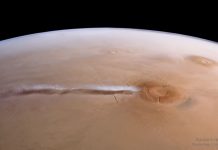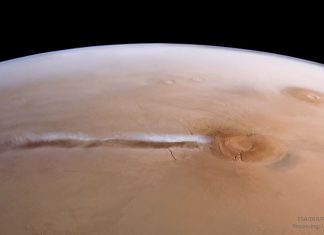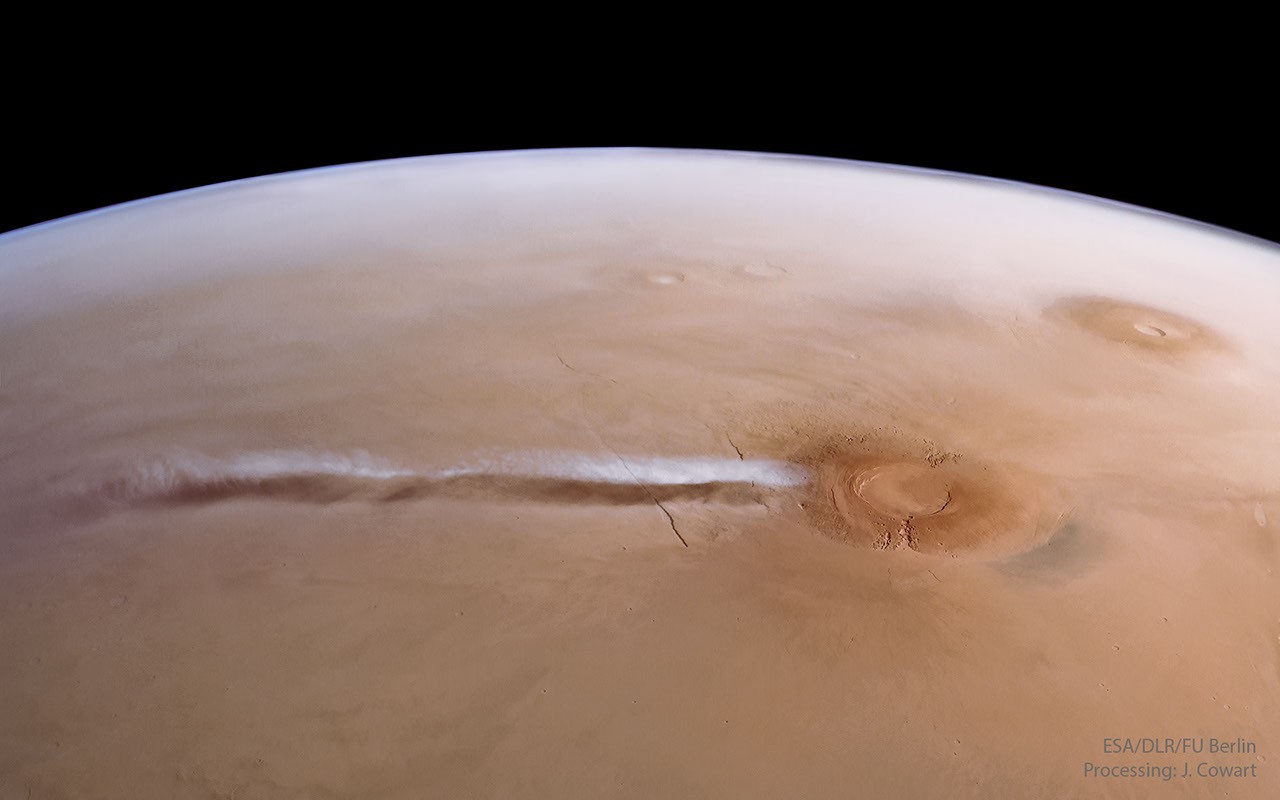
NASA has once again captivated the scientific community with a stunning “Astronomy Picture of the Day” (APOD), this time highlighting a peculiar phenomenon on Mars: an exceptionally long cloud blanketing the Red Planet. This atmospheric anomaly, known as the Arsia Mons Elongated Cloud (AMEC), has been perplexing researchers for decades, and recent imagery from the European Space Agency (ESA) is providing even more details for analysis.
A History of Observation and Unusual Formation Conditions
This remarkable natural formation was first documented by the Viking Orbiter 2 spacecraft in 1977. Since then, scientists have had opportunities to observe AMEC through various Martian missions, including ESA’s Mars Express orbiter, which has supplied more detailed images. The latest data presented by NASA dates back to 2018. Intriguingly, the cloud exclusively forms during the Martian spring and summer months and only in the early morning hours. While typical Martian clouds are composed of water-ice crystals that nucleate around dust particles, this formation mechanism appears unlikely for AMEC. The thin Martian atmosphere and the lack of sufficient dust at high altitudes make conventional cloud formation theories improbable.
Scientific Hypotheses and Implications for Earth’s Atmosphere
The leading hypothesis currently suggests that dust does not play a significant role in the formation of AMEC. Once the cloud originates near the Martian volcano Arsia Mons, powerful winds carry it outward, creating an impressive tail that can extend over 1500 kilometers (approximately 930 miles). Studying this unusual cloud is a crucial step toward a better understanding of atmospheric processes on Mars. The knowledge gained could also assist scientists in better comprehending the complex cloud formation mechanisms on Earth, which is vital for climate modeling and weather forecasting.
Source: NASA