AI research company Anthropic has unveiled a significant advancement for its Claude Managed Agents, introducing dynamic workflow capabilities. This innovation empowers the system to simultaneously manage and coordinate up to 1,000 artificial intelligences, unlocking unprecedented potential for complex task automation.
What Are Dynamic Workflows?
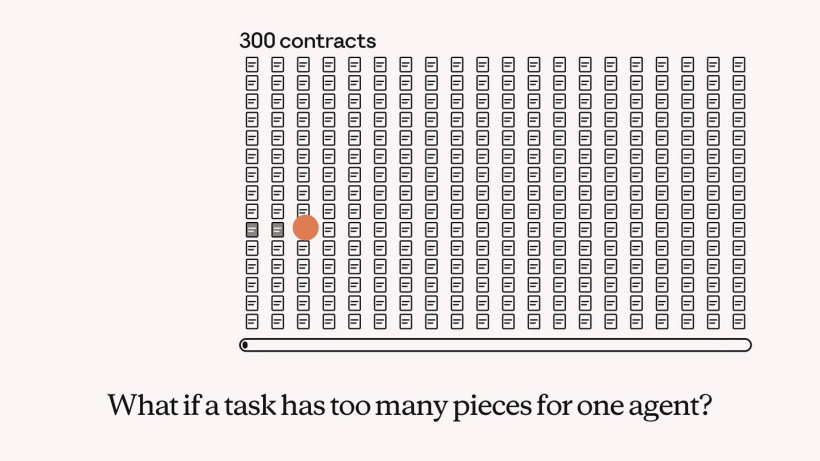
Dynamic workflows represent a powerful mechanism where a primary agent deconstructs a large task into smaller sub-tasks. These sub-tasks are then distributed among numerous auxiliary agents, which execute them in parallel. Once the auxiliary agents complete their work, the primary agent consolidates and summarizes the results.
This approach is particularly effective for scaling large computational tasks, such as deep code analysis or intricate simulations. Unlike sequential processing, dynamic workflows enable the simultaneous handling of multiple task components, dramatically accelerating the overall process.
Demonstrating Capability: Code Bug Detection
To showcase the power of this new functionality, Anthropic conducted a demonstration simulating a software bug detection scenario within a large project. A codebase of 116,000 lines was intentionally injected with 70 bugs.
The testing results were impressive:
- Single Agent: When a single agent was used for code analysis, it identified only 14 to 27 vulnerabilities per execution.
- Dynamic Workflow: The system employing dynamic workflows, utilizing up to 1,000 agents concurrently, consistently detected 66 out of the 70 bugs. This highlights a substantial improvement in analysis accuracy and completeness.
Benefits for Business and Development
The integration of dynamic workflows into Claude Managed Agents holds immense potential across various sectors:
- Software Development: Faster and more accurate bug detection, code optimization, and automated testing.
- Data Analysis: Parallel processing of large datasets, complex simulations, and modeling.
- Scientific Research: Acceleration of computational processes in fields like bioinformatics, physics, or climate modeling.
- Customer Support: More efficient management and distribution of inquiries among specialists.
The ability to manage thousands of AI agents simultaneously positions Claude as a potent tool for tackling challenges that previously required significant human resources and time.
The Future of AI Orchestration
Anthropic’s update marks a significant step forward in the evolution of artificial intelligence. It demonstrates how a large number of AI agents can be effectively orchestrated to achieve complex objectives. This paves the way for the creation of more autonomous and powerful systems capable of addressing real-world problems at scale.