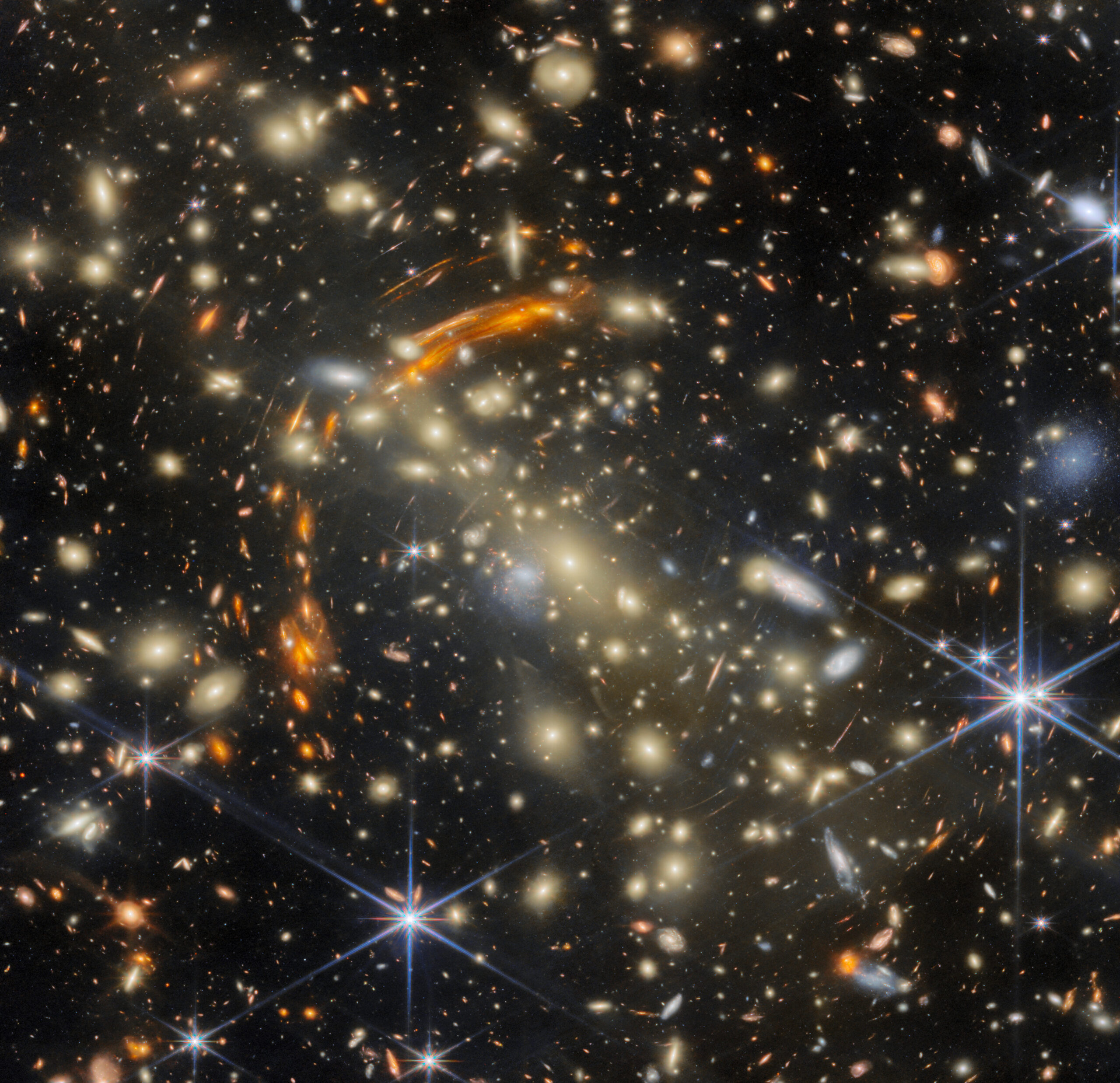
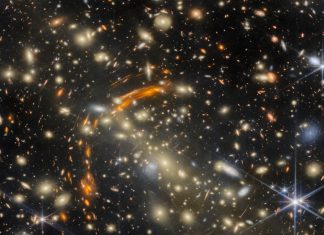
This NASA/ESA/CSA James Webb Space Telescope Picture of the Month features galaxies in incredible detail that have been warped and multiplied like they’ve stepped into a house of mirrors. The brilliant golden galaxies splashed across this image belong to a galaxy cluster called MACS J0454.1-0300. The orange galaxies concentrated on one side of the cluster are not actually part of the cluster; these galaxies are much farther away from us than the galaxies that make up MACS J0454.1-0300. MACS J0454.1-0300 is itself incredibly distant: the light from these galaxies has been travelling to us for so long that we’re seeing the cluster as it was when the Universe was about 8 billion years old. While this galaxy cluster is a valuable scientific target in its own right, the real stars of this image are the galaxies that appear warped and stretched, like a painting that has been smeared by a giant hand. These strange-looking galaxies are of immense interest to astronomers. The way these galaxies look is the result of gravitational lensing, in which the enormous mass of a foreground object such as a galaxy cluster bends and magnifies the light from a more distant object in the background. Gravitational lensing allows astronomers to observe galaxies, star clusters and even individual stars that are too far away for our telescopes to see under normal conditions. While the large, orange galaxies appear obviously distorted, look carefully at some of the small reddish background galaxies throughout this picture: even at the very edges of the frame, there are galaxies whose images have been bent into tiny arcs by MACS J0454.1-0300’s gravity. In addition to making galaxies look stretched out or bent, gravitational lensing can also make us see double — or quadruple. Under certain conditions, multiple images of the same galaxy can appear. It’s rare to see four or more images of the same galaxy, as this requires the position of the background object and the shape of the massiv
The James Webb Space Telescope (JWST) has delivered a breathtaking image, dubbed the “Cosmic House of Mirrors,” showcasing galaxies distorted and multiplied, resembling a surreal hall of mirrors. This phenomenon is a direct consequence of one of the universe’s most astonishing effects: gravitational lensing. This technique allows astronomers to peer further than ever before and study the most distant objects in the cosmos.
How Gravity Creates Cosmic Mirrors
The image is dominated by bright golden galaxies belonging to the MACS J0454.1-0300 cluster. However, the orange galaxies clustered in one part of the frame are not actually part of this cluster. They are located much farther away, and their light has been bent and magnified multiple times by a massive object closer to us – the MACS J0454.1-0300 galaxy cluster itself. This is gravitational lensing: the immense mass of a foreground object (in this case, a galaxy cluster) warps the fabric of spacetime around it, forcing light from more distant objects passing by to travel along a curved path. As a result, we see these distant galaxies in a distorted, often multiple, form, much like looking through a warped mirror.
James Webb: A New View of the Distant Universe
The “House of Mirrors” is more than just a beautiful image; it’s a powerful tool for scientific research. Thanks to JWST’s ability to observe in the infrared spectrum, it can detect light from the earliest galaxies whose radiation has been redshifted due to the expansion of the universe. The gravitational lensing observed in this picture acts as a natural telescope, amplifying the light from these extremely distant objects. This allows astronomers to study the formation of the first stars and galaxies in detail, as well as investigate the nature of dark matter and dark energy, which play a crucial role in the structure and evolution of the universe.