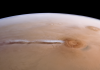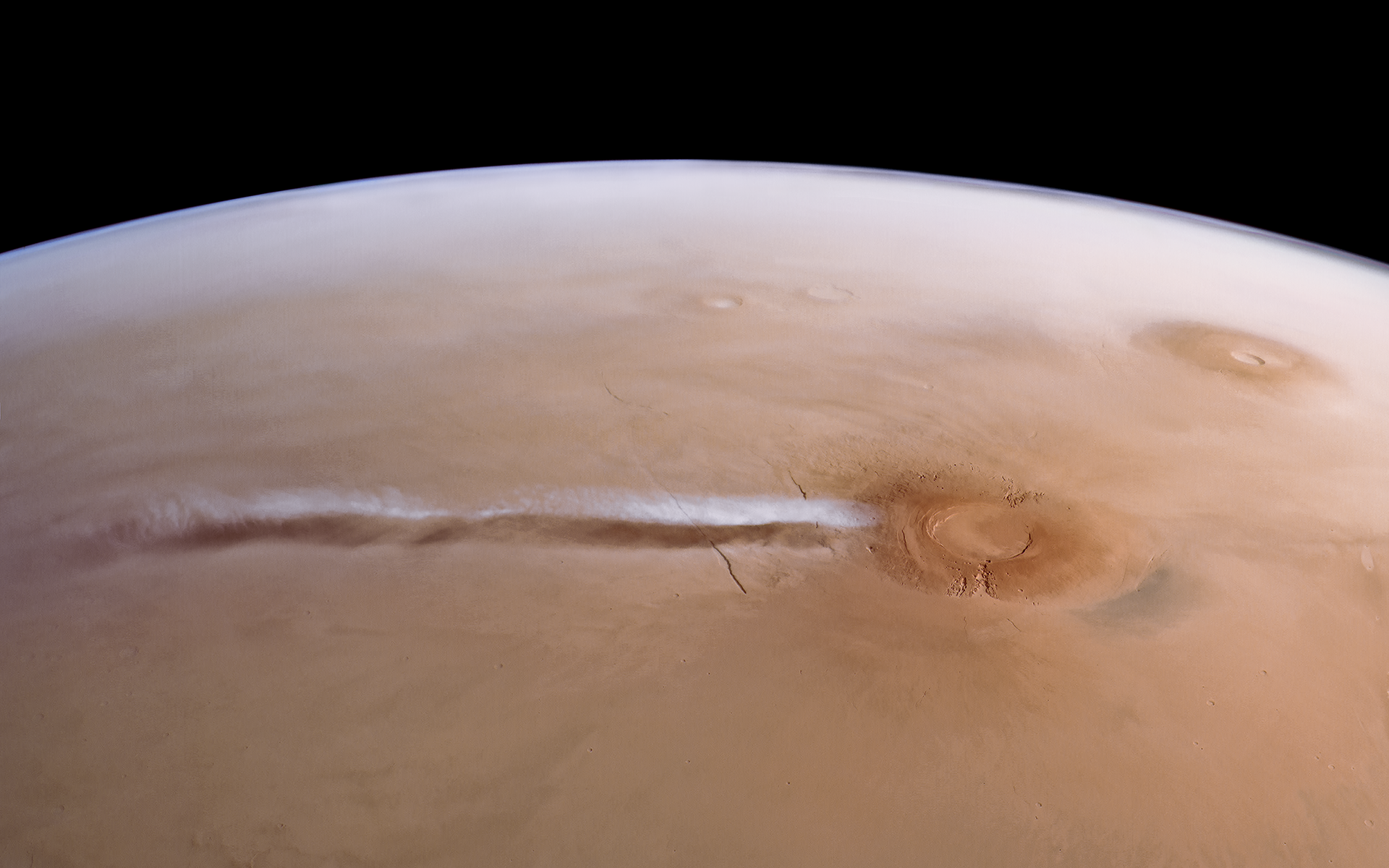
Scientists have found that Mars’s most striking cloud, known as the Arsia Mons Elongated Cloud (AMEC), might be more complex than previously understood, potentially involving exotic physics. Researchers from the European Space Agency (ESA), utilizing data from the Mars Express orbiter and a sophisticated meteorological model of the Red Planet, are delving into the unique phenomenon of this daily cloud formation.
Every spring and summer in Mars’s southern hemisphere, during the planet’s dusty season, the AMEC appears. This visually spectacular cloud, composed of water ice, originates downwind of the massive Arsia Mons volcano, which stands 20 kilometers tall. The cloud forms, grows, and dissipates on a daily cycle, stretching up to an astonishing 1800 kilometers – almost twice the length of the United Kingdom – before vanishing. This remarkable cycle reliably repeats each morning for several months.
While AMEC is a well-known Martian feature, its formation, rapid growth, and swift evaporation have puzzled scientists. The current research suggests that the atmospheric processes at play might be more complex than standard meteorological models can fully explain. The combination of Mars Express’s observational capabilities and advanced modeling aims to uncover the underlying mechanisms driving this persistent and visually dramatic Martian spectacle.