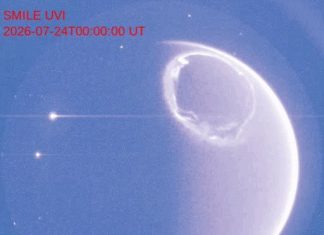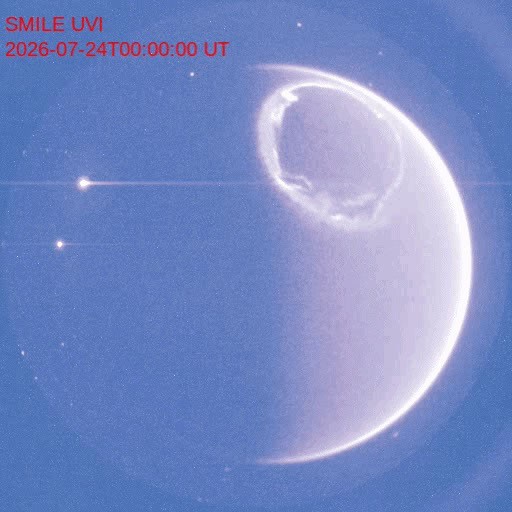
For the first time, scientists have captured a complete, uninterrupted view of Earth’s auroral oval, a luminous ring of light encircling our planet’s magnetic poles. This stunning visualization, released by the SMILE (Solar wind Magnetosphere Ionosphere Link Explorer) spacecraft, offers unprecedented insights into the dynamic interaction between the Sun and our planet. The ability to observe this phenomenon in its entirety is crucial for understanding space weather and protecting vital technologies and human explorers in space.
A Celestial Crown Unveiled
The Aurora Borealis and Australis, commonly known as the Northern and Southern Lights, are a familiar sight for many. However, from our vantage point on the ground, we only ever see a portion of the complete auroral oval. This extensive band of light, stretching across the entire polar region, is too vast to be fully observed from Earth’s surface.
The SMILE mission, a collaborative effort between the European Space Agency (ESA) and the Chinese Academy of Sciences (CAS), has changed this. Its advanced instruments, specifically the Ultraviolet Imager (UVI), have captured the full auroral oval not only during the day but also in full daylight, a feat previously impossible. The recent time-lapse video, spanning about an hour, vividly demonstrates the ever-changing and often turbulent nature of auroras. The tiny points of light visible are distant stars, whose apparent movement is a result of SMILE’s camera perspective shifting as the spacecraft orbits Earth.
Understanding Space Weather’s Impact
The primary objective of the SMILE mission is to unravel the complex relationship between the solar wind – a constant stream of charged particles from the Sun – and Earth’s magnetosphere, the protective magnetic bubble surrounding our planet. By observing the full auroral oval, scientists can gain a deeper understanding of how solar storms, characterized by intense bursts of solar activity, impact Earth.
This knowledge is not just academically interesting; it has direct implications for:
- Protecting astronauts on the International Space Station and during future deep-space missions.
- Ensuring the safety of satellites that provide essential services like communication and navigation.
- Shielding vulnerable ground-based electrical grids from potentially disruptive solar events.
The data gathered by SMILE will be instrumental in improving space weather forecasting, allowing us to better prepare for and mitigate the effects of these powerful cosmic phenomena.
Source: NASA