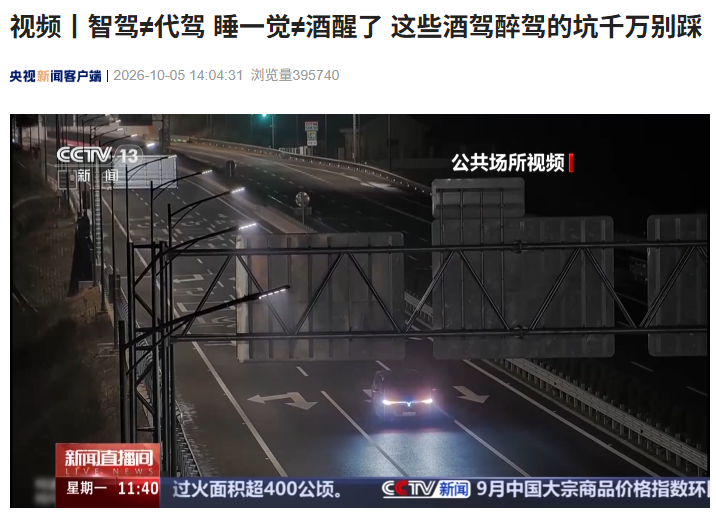
During the recent holiday period, authorities are reminding drivers that while advanced driver-assistance systems (ADAS), often referred to as ‘smart driving’ or ‘智驾’, are becoming increasingly common, they are not a substitute for a human driver. A recent incident highlights the critical importance of understanding the limitations of these technologies.
Smart Driving is Not Self-Driving
The police are emphasizing that ‘smart driving’ features should never be mistaken for ‘self-driving’ or ‘代驾’. This misconception can lead to dangerous situations, as demonstrated by a case where a driver was found asleep in his car on a highway, relying on ADAS.
Highway Incident Underscores Risks
In the early hours of the morning, a new energy vehicle was observed moving slowly and eventually stopping in the middle lane of a highway. Despite the late hour, passing vehicles had to perform emergency maneuvers to avoid a collision. Surveillance systems alerted traffic management, who dispatched a rescue team.
Upon arrival, rescuers found the driver, identified as Qiu, unconscious in the vehicle. After waking him, they moved his car to a nearby exit. During this process, rescuers detected a strong smell of alcohol on Qiu and immediately reported the potential for drunk driving.
Drunk Driving and Legal Consequences
Police arrived and conducted a breathalyzer test, which registered 111mg/100ml. A subsequent blood test at the hospital confirmed a blood alcohol content of 123mg/100ml, exceeding the legal limit for drunk driving.
Qiu confessed that he had consumed about half a kilogram of baijiu (Chinese liquor) with friends earlier that evening. After dinner, he drove onto the highway towards Hangzhou, activating the smart driving function.
As a result of his actions, Qiu has had his driver’s license revoked for five years, preventing him from re-applying. Furthermore, he has been convicted of dangerous driving and sentenced to criminal detention and a fine by the court.
Legal Precedents and ADAS Responsibility
This incident echoes broader concerns about the misuse of ADAS. In February of this year, China’s Supreme People’s Court released guiding cases clarifying the legal responsibilities of drivers when ADAS is active. These cases underscore that even when ADAS is engaged, the human driver remains responsible for ensuring road safety.
The court’s guidance, particularly Case No. 271 regarding Wang Mouqun’s dangerous driving, explicitly states that ADAS cannot replace the driver. Drivers who activate these systems must remain attentive and in control of the vehicle. The ruling also addresses the use of illegal accessories designed to bypass ADAS safety monitoring, stating that drivers using such devices, even if not physically steering, are still considered the primary operator and are legally liable.
The increasing sophistication of vehicles means drivers must maintain a clear understanding of what these systems can and cannot do. Relying on smart driving features to the extent of neglecting personal responsibility, whether by sleeping, using a phone, or employing unauthorized modifications, poses a significant threat to public safety.