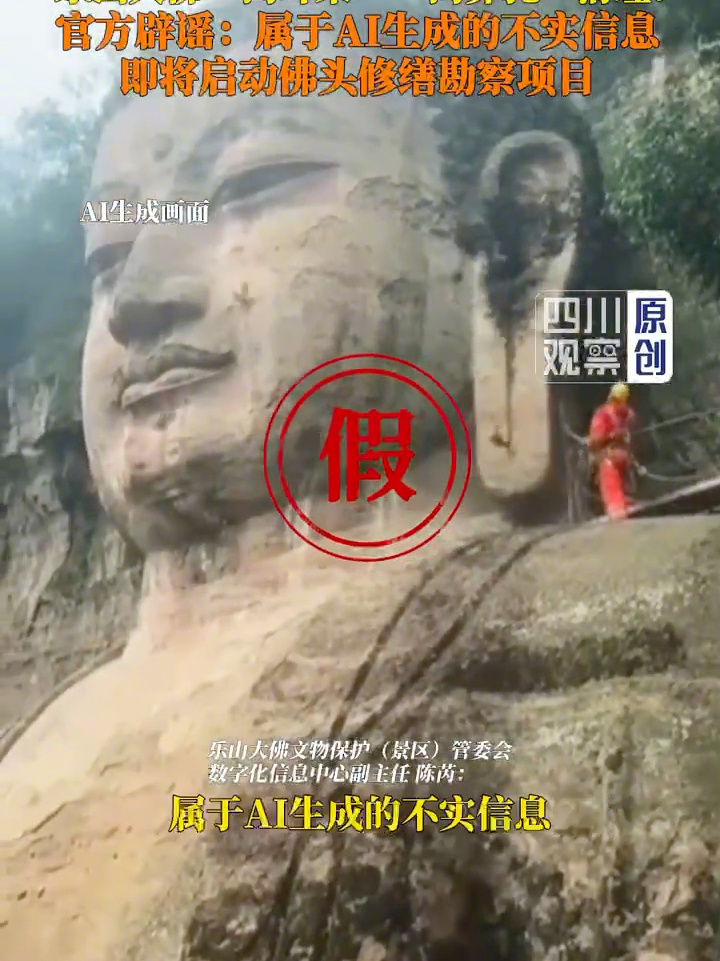
A viral video purporting to show conservation workers cleaning the ears of the Leshan Giant Buddha has been officially debunked by the scenic area’s management committee. The footage, which depicted workers removing pigeons and leaves from the Buddha’s ear and nostrils, along with a monkey interacting with a worker’s hard hat, has been confirmed as an artificial intelligence (AI) generated fabrication.
AI-Generated Content Sparks Misinformation
The Leshan Giant Buddha Scenic Area Administration Committee addressed the circulating video, stating unequivocally that it does not represent a real scene within the premises. A spokesperson for the committee clarified that the video was created using AI and urged the public not to believe or spread such misinformation.
Actual Conservation Efforts Detailed
Chen Rui, the Deputy Director of the Digital Information Center at the Leshan Buddha Cultural Protection (Scenic Area) Management Committee, provided details about the site’s recent maintenance activities. He explained that since 2026, the Leshan Giant Buddha has undergone five maintenance sessions. The most recent, from September 20th to 25th, focused on repairing micro-damages to the rock surface, cleaning microbial growth, and removing surface vegetation. These genuine conservation efforts bear no resemblance to the fabricated scenes in the viral video.
Furthermore, Chen Rui confirmed that there are no foreign objects within the Buddha’s ear or nasal cavities that require cleaning. He also debunked the presence of monkeys in the Lingyun Mountain area where the Buddha is located, directly contradicting the imagery presented in the AI-generated video.
Legal Ramifications of Deepfakes and Misinformation
The incident highlights the growing concerns surrounding AI-generated content, particularly deepfakes, and their potential to mislead the public. Regulations such as the ‘Measures for the Management of Deep Synthesis of Internet Information Services’ and the ‘Interim Measures for the Management of Generative Artificial Intelligence Services’ in China strictly prohibit the creation of AI-generated content that falsely represents facts and misleads the public. Such content is required to bear a conspicuous AI identification mark.
Moreover, both the ‘Cybersecurity Law’ and the ‘Law on the Protection of Cultural Relics’ in China explicitly forbid the fabrication and dissemination of false information related to cultural heritage. Spreading rumors that disrupt public order can lead to detention and fines under the ‘Law on the Administration of Public Security Punishments’.
The Leshan Giant Buddha, a UNESCO World Heritage site, is a monumental statue carved out of a cliff face in the southwestern Chinese province of Sichuan. Its preservation is a matter of significant cultural importance, making the spread of false information about its maintenance a serious concern.
The committee’s swift response and clarification serve as a crucial reminder for netizens to exercise critical judgment when encountering sensational online content and to rely on official sources for accurate information, especially concerning cultural heritage sites.