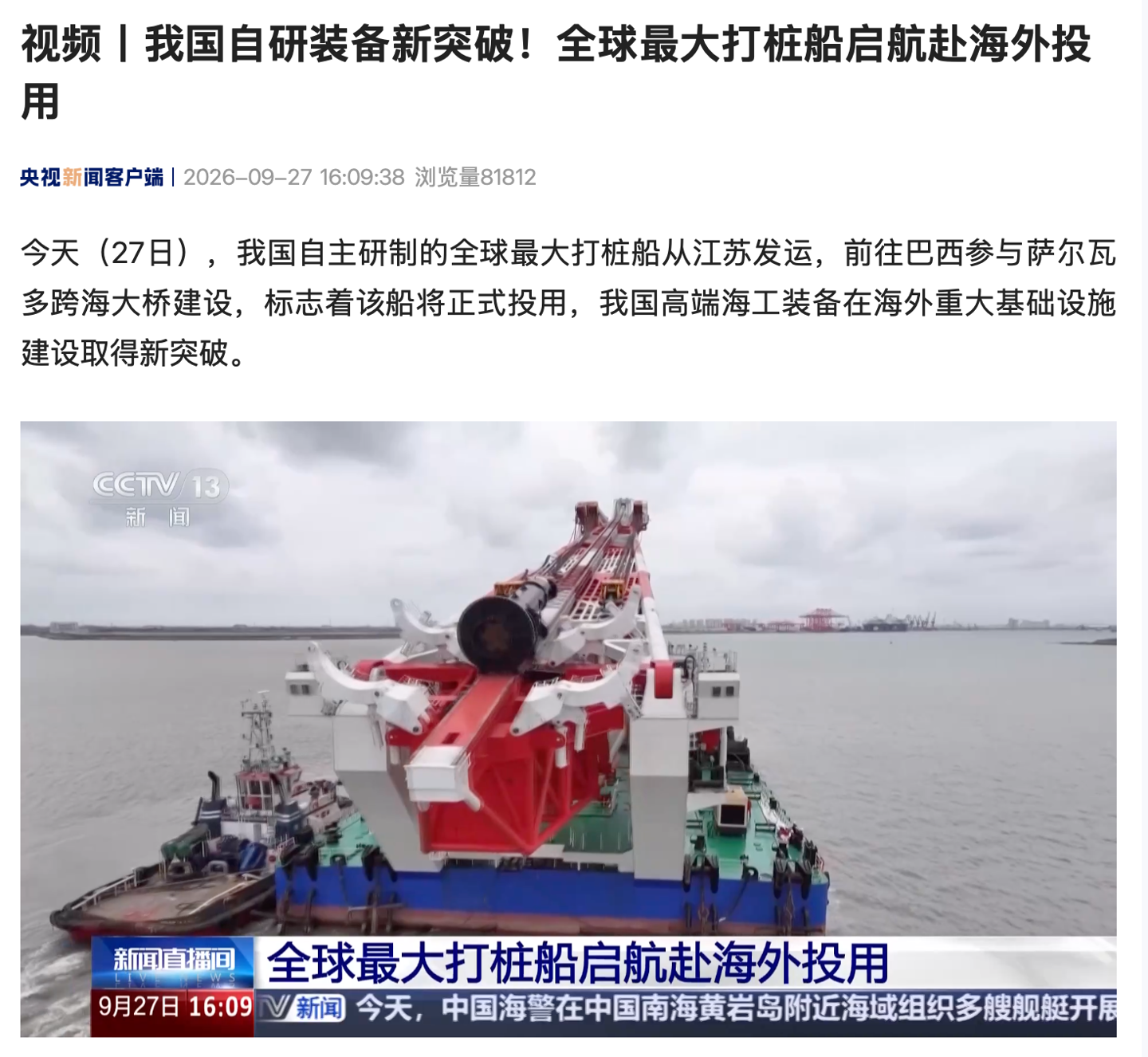
China has achieved a significant breakthrough in high-end offshore engineering equipment with the successful launch of its indigenously developed, world’s largest piling ship. This colossal vessel has departed from Jiangsu, China, bound for Brazil, where it will play a crucial role in the construction of the Salvador Transbay Bridge. This marks a pivotal moment for Chinese-made marine engineering gear in major international infrastructure projects.
A Giant of the Seas
The piling ship, a specialized vessel designed for underwater piling operations, is tasked with precisely driving massive piles into the seabed. This particular ship boasts impressive specifications: a total length of 130.5 meters, a piling frame height of 156 meters, an operational water depth of 70 meters, and a lifting capacity of 700 tons. These dimensions make it the tallest piling ship globally, with the greatest lifting capacity and the deepest operational water depth, enabling it to handle construction requirements in ultra-deep waters with exceptionally large piles.
The journey from the Yangtze River estuary to Brazil is an extensive one, covering 11,300 nautical miles and an estimated 45 days of sailing. The ship’s destination is the construction site of the Salvador Transbay Bridge on the northeast coast of Brazil.
Technological Prowess
Several advanced technologies have been integrated into this groundbreaking vessel. For the first time on a large-scale piling ship, a hybrid positioning system combining dynamic positioning and anchor positioning has been employed. Coupled with China’s indigenously developed Beidou high-precision satellite positioning system, the piling accuracy achieves centimeter-level precision. Additionally, the ship features a newly applied closed-loop hydraulic system for the main cylinder, achieving an impressive energy recovery rate of 40%.
Crucially, from the initial design phase through to the production of core components and ongoing maintenance, the entire process of building this piling ship has been under China’s independent and controllable technological development. This self-reliance underscores the nation’s growing capabilities in advanced maritime engineering.
The Salvador Transbay Bridge Project
The Salvador Transbay Bridge project itself is a significant undertaking, spanning Brazil’s largest bay, the Bay of All Saints. The main bridge pile foundations are situated in waters with a depth of 64 meters.
Upon completion, the bridge is expected to dramatically improve connectivity and transportation efficiency in the region. The travel time between Salvador city and Vera Cruz city will be reduced from approximately one hour by ferry to just about 15 minutes. Furthermore, the project will shorten the cargo transport distance for goods such as grain, cotton, and fruits produced in western Bahia by 200 kilometers, significantly boosting regional trade and economic development.
This deployment represents not only a major step for China’s offshore equipment manufacturing but also a vital contribution to a key infrastructure project in Brazil, highlighting international collaboration in large-scale engineering endeavors.