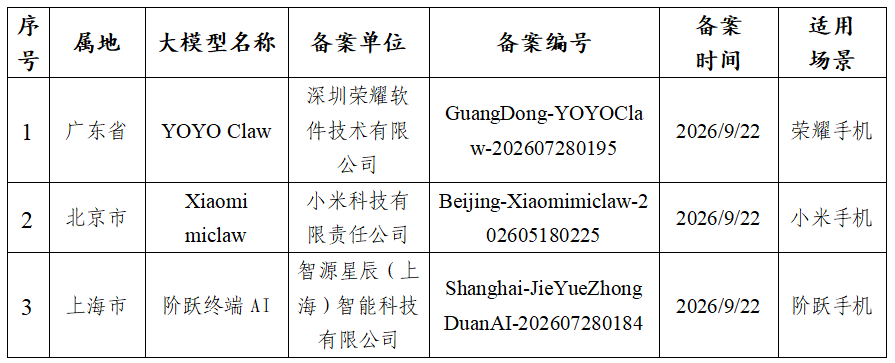
China’s cyberspace administration has officially approved three new on-device generative AI services for mobile phones, marking a significant step in the country’s regulatory framework for artificial intelligence. The newly registered services include ‘YOYO Claw’ by Shenzhen Honor Software Technology Co., Ltd., ‘Xiaomi miclaw’ by Xiaomi Technology Co., Ltd., and ‘JieYue ZhongDuan AI’ by Zhiyuan Xingchen (Shanghai) Intelligent Technology Co., Ltd.
Regulatory Approval Process
The approvals were made in accordance with the ‘Interim Measures for the Management of Generative Artificial Intelligence Services,’ a set of regulations introduced to govern the development and deployment of AI technologies in China. The cyberspace administration, in conjunction with other relevant departments, has been systematically processing applications for generative AI services. This recent announcement adds three more services, specifically those operating on the device level for mobile phones, to the official registry.
Details of the Approved Services
The three newly approved services are:
- YOYO Claw: Developed by Shenzhen Honor Software Technology Co., Ltd., this service is associated with Honor smartphones and is registered in Guangdong province under the备案编号 (filing number) GuangDong-YOYOClaw-202607280195. The备案时间 (filing date) is September 22, 2026.
- Xiaomi miclaw: Developed by Xiaomi Technology Co., Ltd., this service is for Xiaomi smartphones. It is registered in Beijing under the备案编号 Beijing-Xiaomimiclaw-202605180225, with a filing date of September 22, 2026.
- JieYue ZhongDuan AI: Developed by Zhiyuan Xingchen (Shanghai) Intelligent Technology Co., Ltd., this service is intended for JieYue smartphones and is registered in Shanghai under the备案编号 Shanghai-JieYueZhongDuanAI-202607280184. The filing date is also September 22, 2026.
All three services are designated for use cases within their respective mobile phone ecosystems.
Implications for Mobile AI
The approval of these on-device generative AI services signals a move towards more integrated and potentially private AI experiences on mobile devices. Unlike cloud-based AI services, on-device AI processes data locally, which can offer benefits in terms of speed, reduced latency, and enhanced user privacy, as sensitive information may not need to be transmitted to external servers. This aligns with global trends in AI development, where edge computing and on-device processing are gaining prominence.
For smartphone manufacturers like Honor and Xiaomi, securing these approvals is crucial for integrating advanced AI features directly into their hardware and software. This allows for unique user experiences and competitive differentiation in the crowded smartphone market. The involvement of Zhiyuan Xingchen suggests potential partnerships or a broader ecosystem approach to AI development in China.
The Regulatory Landscape
The ‘Interim Measures for the Management of Generative Artificial Intelligence Services’ were implemented to ensure that the development and deployment of generative AI are conducted in a safe, orderly, and ethical manner. The registration process requires service providers to meet specific security and compliance standards. By bringing these services under a formal regulatory framework, Chinese authorities aim to balance innovation with risk management, particularly concerning content generation, data security, and potential societal impacts.
The systematic approach to备案 (filing/registration) by the cyberspace administration indicates a proactive stance in overseeing the rapidly evolving field of generative AI. As more AI services are developed, particularly for mobile platforms, this regulatory framework will likely continue to shape how these technologies are implemented and utilized by consumers across China.