iFlytek, a leading artificial intelligence company, has announced the launch of its latest generation large model for speech recognition, Spark-ASR-2.0. This advanced model is set to roll out on the iFlytek Input Method starting tomorrow, promising a significant upgrade in voice-to-text capabilities.
Revolutionary Technologies Powering Spark-ASR-2.0
The new Spark-ASR-2.0 model is built upon several key technological innovations. These include a synergistic approach combining non-autoregressive and LLM-enhanced autoregressive models, joint enhancement of mixed Chinese-English text and acoustics, and dynamic context injection. These advancements have collectively led to a substantial improvement in overall speech recognition performance.
iFlytek highlights that Spark-ASR-2.0 excels particularly in several critical areas:
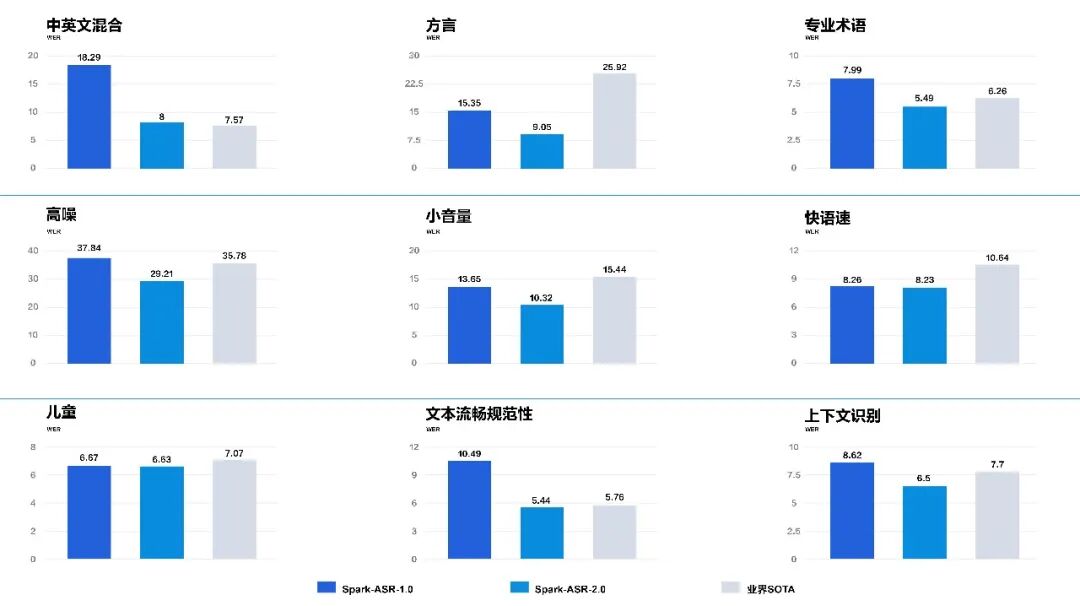
- General Recognition: Improved accuracy for mixed Chinese-English speech, dialects, and specialized terminology.
- Complex Acoustic Scenarios: Enhanced performance in noisy environments, with low volume, fast speech rates, and even in recognizing children’s voices.
- Contextual Understanding: Better comprehension and utilization of context for more accurate transcriptions.
- Text Fluency and规范性 (Standardization): The output text is more coherent, grammatically correct, and semantically clear.
Remarkably, despite these significant performance gains, the overall inference cost for Spark-ASR-2.0 has only increased by 10% compared to its predecessor, Spark-ASR-1.0. This efficiency ensures that the advanced technology can be widely deployed.
Beyond Accuracy: Fluency and Clarity
iFlytek’s vision for Spark-ASR-2.0 goes beyond mere verbatim transcription. “If past speech recognition aimed to reproduce spoken content word-for-word, then Spark-ASR-2.0 goes a step further, making the recognition results ‘fluent into text’ – while improving recognition accuracy, it combines contextual logic and situational understanding to streamline redundant expressions and refine various details, making the text more coherent and the semantics clearer,” the company stated.
Superior Performance Benchmarked
When compared to Spark-ASR-1.0, Spark-ASR-2.0 demonstrates noticeable progress across all core speech recognition scenarios. The Word Error Rate (WER) has been significantly reduced, especially in dimensions like mixed Chinese-English, dialects, noisy environments, and text standardization.
iFlytek claims that Spark-ASR-2.0 holds a significant advantage over the current industry’s best levels in dialect recognition, high-noise environments, and low-volume speech. This underscores the model’s robust capabilities in challenging acoustic conditions, with performance on key tasks reportedly surpassing existing industry benchmarks.
The evaluation metrics used for ASR tasks in the test sets are WER and CER (Character Error Rate), where lower scores indicate better performance. These test sets are derived from real-world voice task requests, with data sources including the iFlytek Spark APP, iFlytek Tingjian APP, iFlytek Translation Pen, iFlytek Input Method, and actual developer scenarios from the iFlytek Open Platform’s voice API, all subject to continuous updates.
Rollout and Future Applications
Starting tomorrow, Spark-ASR-2.0 will be gradually implemented in the iFlytek Input Method. Additionally, iFlytek will make the API services for Spark-ASR-2.0 available through its Open Platform.
The application of Spark-ASR-2.0 is not limited to the input method. iFlytek plans to integrate this advanced speech recognition technology into a range of its other products and services. These include the iFlytek AI Glasses, iFlytek Smart Office Notebook, and iFlytek Tingjian (a speech-to-text service), among others, further solidifying iFlytek’s position as a leader in AI-powered communication tools.