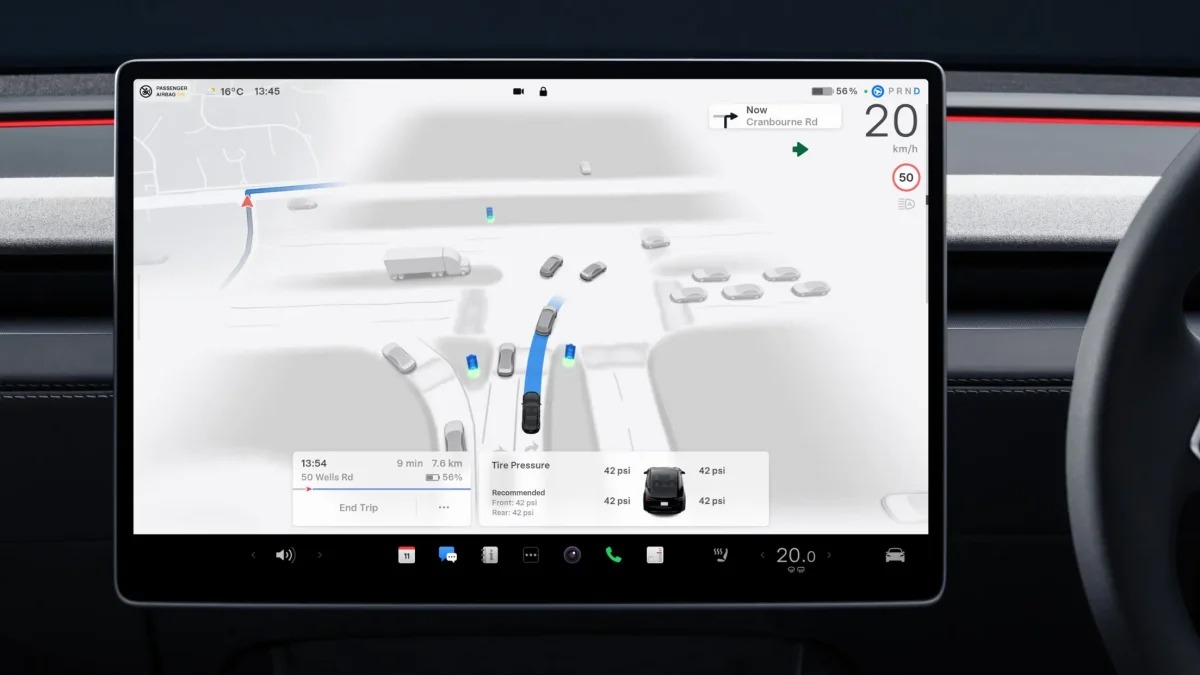
It has been one year since Tesla’s Full Self-Driving (Supervised) system launched in Australia and New Zealand. To mark this significant milestone, Tesla’s official X account for the region has released detailed safety results from the past 12 months of the system operating on Australasian roads. The data reveals that vehicles operating with FSD (Supervised) experienced a 40% reduction in average collision rates compared to human driving.
Detailed Safety Statistics Unveiled
The fleet statistics cover the period from September 17, 2025, to September 16, 2026. During this time, Tesla compared 160 million kilometers driven with FSD (Supervised) engaged against 2.4 billion kilometers of human driving, with all vehicle active safety features enabled. The statistics encompass all types of collisions, both minor and major.
The data indicates that with FSD engaged, a collision occurred on average every 1.78 million kilometers. In contrast, under human driving conditions, a collision occurred approximately every 1.07 million kilometers, resulting in an overall 40% decrease in collision frequency.
Beyond just collision rates, the statistics show a significant reduction in driver interventions and harsh maneuvers. Automatic Emergency Braking (AEB) events decreased by 66%, with AEB triggering once every 17,432 kilometers in FSD mode versus once every 5,989 kilometers during human driving. Harsh braking events saw a reduction of 90%, occurring once every 1,823 kilometers in FSD mode compared to once every 180 kilometers when driven manually. Abrupt acceleration instances dropped by 86%.
Further analysis highlights improvements in vehicle control. Sharp lateral steering actions during cornering were reduced by 76%. Even the frequency of horn usage saw an 80% decrease. With FSD active, the horn was used on average once every 3,233 kilometers, while during manual driving, it was used approximately once every 643 kilometers.
Global Expansion and Software Updates
Tesla’s FSD system has now expanded to 14 countries globally, with its rollout continuing as more European nations grant approvals. Earlier this month, Slovenia became the latest country to permit the technology on its roads.
Here is an overview of FSD’s current global rollout:
- United States: October 2020 (HW3)
- Canada: March 2022 (HW3)
- Mexico: February 2025 (HW4 / AI4)
- Puerto Rico: February 2025 (HW4 / AI4)
- China: February 2025 (Limited – HW4 / AI4)
- Australia: September 2025 (HW4 / AI4)
- New Zealand: September 2025 (HW4 / AI4)
- South Korea: November 2025 (HW4 / AI4)
- Netherlands: April 2026 (HW4 / AI4)
- Lithuania: May 2026 (HW4 / AI4)
- Estonia: May 2026 (HW4 / AI4)
- Denmark: June 2026 (HW4 / AI4)
- Belgium: June 2026 (HW4 / AI4)
- Slovenia: September 2026 (Pending deployment – HW4 / AI4)
Alongside market expansion, software development is progressing rapidly. Earlier this summer, Tesla deployed FSD v14 to Australia and New Zealand, introducing the latest end-to-end neural network architecture to the region. Owners in these markets initially used FSD v13 upon launch. The next major platform update, FSD v15, is anticipated later this year or early next year and will also be rolled out to the Australasian region.
Owners with older HW3 hardware will also receive important updates. Tesla confirmed last month that FSD v14 Lite, developed specifically for these two countries, is under accelerated development. This version utilizes model distillation technology to adapt to older processors, ensuring smooth operation.