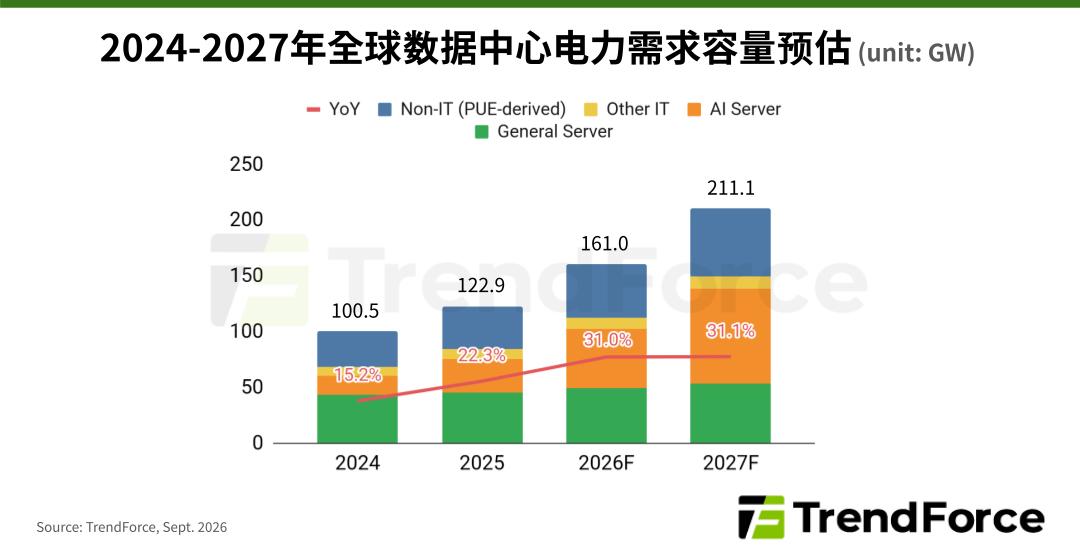
The rapid advancement of Artificial Intelligence is facing a new, significant bottleneck: not a lack of processing chips, but a deficit in electricity and robust power grids. A recent report by global market intelligence firm TrendForce indicates that the focus for AI infrastructure development is shifting from semiconductor supply to power availability.
AI’s Growing Power Appetite
TrendForce’s research on the AI server industry highlights a dramatic increase in the electricity demand from AI servers within data centers. Projections show this demand will surge from approximately 25% of a data center’s total power consumption in 2025 to an estimated 33.4% in 2026. By 2027, AI servers could account for over 40% of the power needs, signaling a profound reshaping of cloud computing infrastructure around AI capabilities.
Grid Capacity Strain
The implications for global power grids are substantial. TrendForce estimates that the worldwide electricity demand for data centers will reach about 161 GW in 2026, a significant 31% year-over-year increase. However, the pace of grid upgrades, including the necessary infrastructure for power access, transformer capacity, transmission lines, and cooling systems, may not keep up. This potential lag could delay the launch of new data center facilities.
A Widening Gap by 2030
The disparity between power demand and supply is expected to widen considerably after 2028. According to TrendForce’s scenario analysis, by 2030, the demand for data center power capacity could soar to 490.7 GW. In stark contrast, the grid’s estimated capacity to supply data centers would only reach around 222.6 GW, leaving a projected shortfall of approximately 268 GW.
Echoes from Industry Leaders
This concern is not new to the industry. Previously, at the SEMICON Taiwan 2026 event, Google announced the expansion of its Tensor Processing Unit (TPU) system to a million-chip scale. During the announcement, Amin Vahdat, Google’s Chief Technology Officer, emphasized that power supply has become the core constraint for the expansion of AI infrastructure. He stated that as AI models grow in complexity and size, the primary limitation is shifting from the ability to manufacture chips to securing sufficient electrical power, effectively turning the AI compute ceiling from “can’t build chips” to “can’t find electricity.”.
Rethinking AI Infrastructure
The findings from TrendForce and the insights from tech giants like Google underscore a critical challenge for the future of AI. While advancements in chip technology continue to push boundaries, the foundational need for reliable and scalable power infrastructure is becoming increasingly paramount. Addressing this power deficit will require significant investment and strategic planning in grid modernization and renewable energy integration to ensure the continued growth and deployment of AI technologies worldwide.