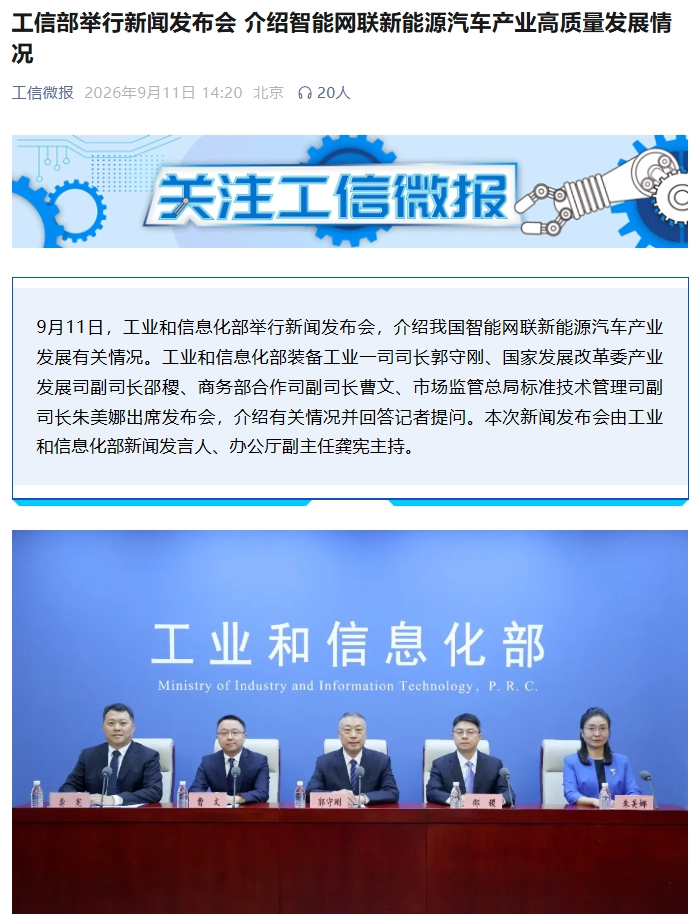
China’s Ministry of Industry and Information Technology (MIIT) has unveiled ambitious plans and impressive growth figures for the nation’s smart connected new energy vehicle (NEV) sector. During a press conference on September 11th, MIIT officials highlighted significant achievements and outlined strategies for continued development through the 15th Five-Year Plan period (2026-2030).
Rapid Growth and Global Leadership
Guo Shougng, Director of the MIIT’s Department of Equipment Industry I, stated that China’s NEV industry has made remarkable progress, establishing a considerable competitive advantage globally and taking solid steps towards becoming an automotive powerhouse.
Technologically, China is now at the forefront in areas such as vehicle integration, power batteries, smart cockpits, and LiDAR. Advanced driving assistance functions are also becoming increasingly widespread.
The country has built a complete and efficient industrial chain covering upstream and downstream sectors. Notably, China’s output of NEVs, power batteries, and key materials now accounts for over 70% of the global share. Furthermore, five Chinese NEV manufacturers and six power battery companies rank among the top 10 globally in sales.
Market scale has seen explosive growth. From 2020 to 2025, the annual sales of NEVs are projected to surge from 1.367 million units to 16.49 million units, representing an average annual compound growth rate (CAGR) of 65%. The adoption rate of advanced driving assistance functions in domestic passenger vehicles is expected to climb from 16.2% to 64.9% during the same period.
Beyond domestic dominance, China’s NEVs and components are exported to over 100 countries and regions. This international reach, coupled with deepening cooperation between Chinese and foreign enterprises, signifies a significant contribution to the global automotive industry’s green and low-carbon transition.
Addressing Challenges and Future Strategies
Despite the impressive progress, MIIT acknowledged existing challenges. These include rising international protectionism and unilateralism, increased trade barriers, and persistent issues of irrational domestic competition. Recent incidents concerning vehicle quality and autonomous driving safety also require careful attention and response.
Looking ahead to the 15th Five-Year Plan, MIIT, in conjunction with relevant departments, has developed the “15th Five-Year Plan for the Development of the Smart Connected New Energy Vehicle Industry.” This plan aims to accelerate the industry’s move towards green, intelligent, high-end, and international development.
Key Development Pillars:
- Green Development: This involves continuously revising energy consumption standards, optimizing the “dual credit” policy, exploring carbon emission and battery carbon footprint management, and establishing a digital identity system for power batteries. Initiatives like “trade-in” programs, NEVs for rural areas, and pilot programs to address charging infrastructure gaps in counties will be promoted to ensure full charging station coverage.
- Intelligent Development: The focus will be on advancing pilot programs for smart connected vehicle access and road access, as well as “vehicle-road-cloud integration” applications. Management systems for production access will be optimized, and efforts will be made to build trusted data spaces and high-quality datasets. Support will be provided for synergistic innovation between the automotive sector and information communication, energy, and transportation industries. Deep integration of artificial intelligence (AI) with the automotive industry will drive digital and intelligent transformation across the entire value chain.
- High-end Development: Key enterprises will be supported in intensifying technological research and development. This includes enhancing the low-temperature performance and durability of power batteries, improving the advancement, safety, and reliability of driving assistance and autonomous driving systems, and ultimately elevating product quality. Stricter review and testing for product innovation access, alongside enhanced supervision of production consistency, will ensure that only safe, reliable, and thoroughly validated products reach the market.
- International Development: China will leverage bilateral and multilateral exchange mechanisms to actively participate in international standards and regulations coordination, promoting alignment and mutual recognition between domestic standards and global regulations. Improvements in supporting infrastructure for cross-border logistics, financing, and investment will facilitate steady progress in international trade and investment cooperation, further contributing to the global automotive industry’s transformation and upgrading.
With a vast development prospect and a promising future, China’s smart connected NEV industry is poised for continued significant growth and innovation in the coming years.