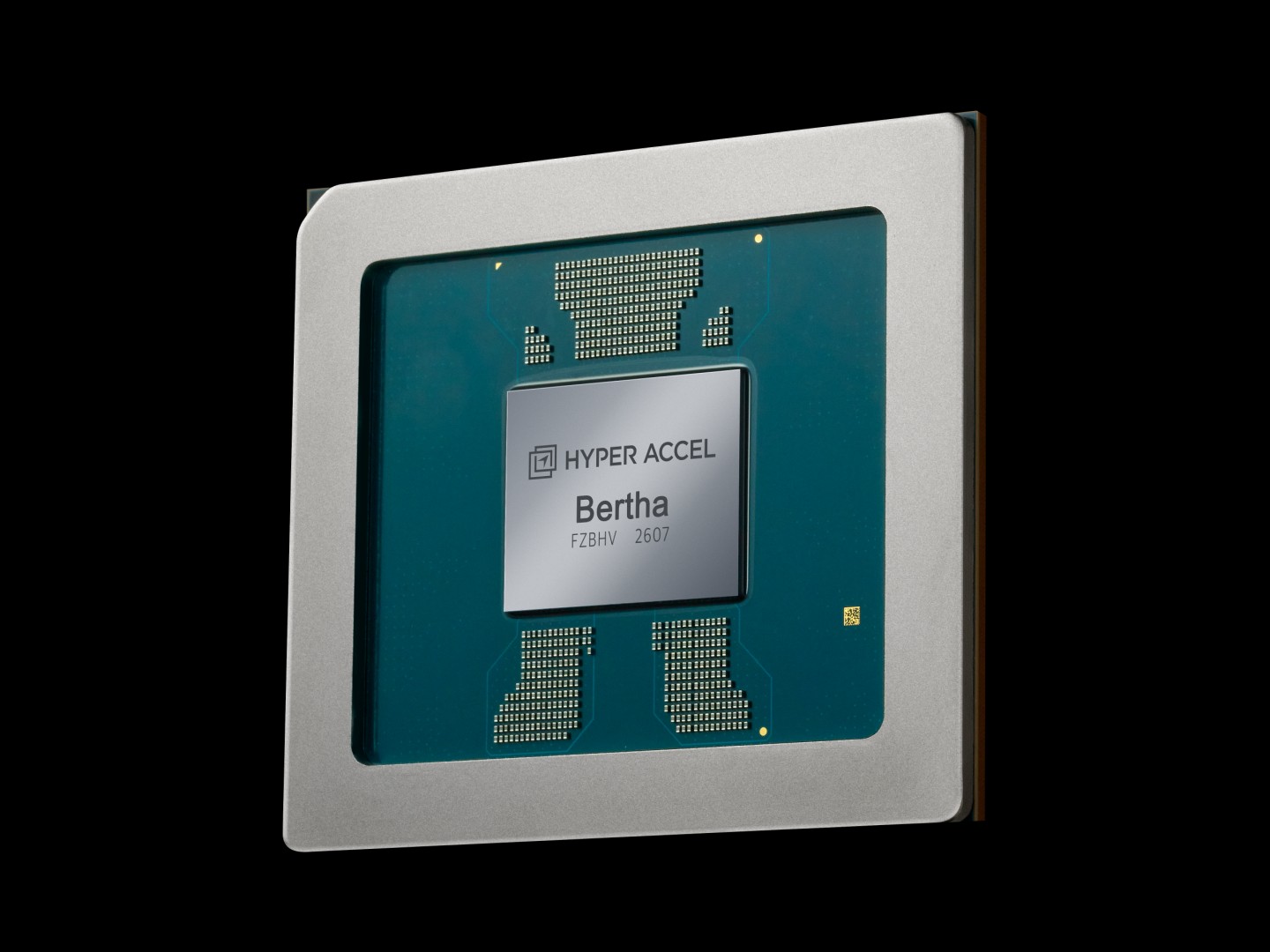
South Korean AI chip startup HyperAccel has announced a significant milestone: its flagship AI inference accelerator chip, codenamed ‘Bertha,’ is now in mass production. This advanced chip is designed specifically for data center applications and is being manufactured using Samsung Foundry’s cutting-edge 4nm process node.
The ‘Bertha 500’ chip, designed by HyperAccel and produced through SEMIFIVE’s services, boasts an impressive 500mm² die size. This powerful chip offers a substantial 768 TFLOPS of FP8 compute performance. It demonstrates broad data format support, including FP16/8/4 and INT8/4, making it versatile for a wide range of AI workloads.
To ensure rapid data access and processing, the Bertha 500 integrates 256MB of on-chip SRAM cache. Additionally, it connects externally to 128GB or 256GB of LPDDR5X memory, delivering a memory bandwidth of 546GB/s. This configuration is likely based on a 512-bit interface running at 8533MT/s, providing the necessary throughput for demanding AI tasks.
The chip operates with a Thermal Design Power (TDP) of 250W and is presented in a dual-slot PCIe Add-in-Card (AIC) form factor, making it compatible with standard server infrastructure. HyperAccel has made bold claims regarding Bertha 500’s performance compared to NVIDIA’s H100 AI accelerator. The company asserts that Bertha 500 can achieve up to twice the throughput, an astounding 19 times the cost-effectiveness, and 12 times the energy efficiency of the H100.
While Bertha 500 targets data center inference, HyperAccel also has another chip variant, ‘Bertha 100,’ which is designed for edge deployment scenarios. This suggests a broader strategy to address diverse AI computing needs across different environments.
The mass production of Bertha 500 on a 4nm process signifies a major step forward for HyperAccel and highlights the growing competition in the AI chip market, particularly for data center inference. The company’s aggressive performance and efficiency claims will undoubtedly put pressure on established players and attract attention from cloud providers and enterprises looking for more cost-effective and power-efficient AI solutions.
SEMIFIVE, a key partner in this development, provides comprehensive chip design services, from architecture to implementation, and facilitates access to advanced manufacturing processes like Samsung’s 4nm node. This collaboration underscores the trend of specialized design service companies playing a crucial role in bringing innovative silicon to market.
As AI adoption continues to accelerate across industries, the demand for specialized hardware like Bertha 500 is expected to surge. HyperAccel’s entry into mass production with a chip promising such significant improvements in performance and efficiency could be a game-changer for data center AI operations.