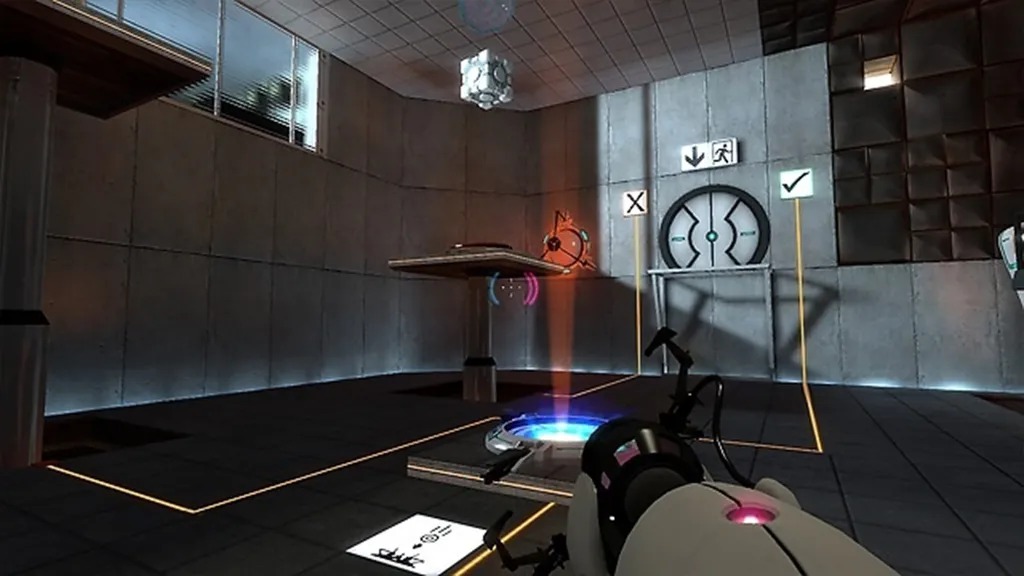
In a significant advancement for artificial intelligence, OpenAI’s latest model, GPT-6 Astra, has successfully navigated and completed Valve’s challenging 3D puzzle game, Portal. This achievement marks a substantial leap from AI’s earlier struggles, even in simpler games like Atari 2600 chess, showcasing a powerful demonstration of multimodal “AI intelligence.” The entire process, which involved 3336 tool calls, incurred a cost of $571.18, though the experimenter, CozyBlaze, clarified that this was covered by a monthly $200 Codex Pro subscription.
The AI utilized a method dubbed Model Context Protocol (MCP) and a modified SourcePauseTool (SPT) to control the game. According to CozyBlaze, the game would pause while the model processed information and formulated its next steps. Upon receiving a set of input commands from the AI, the SPT would then unpause the game to execute the actions. During the AI’s ‘thinking’ phase, it was provided with game screenshots and the player character’s location, allowing it to plan its strategy before gameplay resumed.
This explains the discrepancy between the edited highlight reel, which clocks in at about two hours, and the full 24-hour continuous live stream of GPT-6 Astra’s playthrough. CozyBlaze, while celebrating the success, remains pragmatic. He acknowledged that numerous challenges still need addressing and cautioned against viewing this accomplishment as a standardized benchmark for AI capabilities.
However, seeing a general-purpose agent autonomously explore a game world and ultimately complete the entire game feels like the initial vision is gradually coming to fruition.
CozyBlaze’s reference to the “initial vision” points to OpenAI’s long-standing goal, first articulated in 2016, to create a single AI agent capable of tackling a diverse range of gaming tasks. The introduction of GPT-6 Astra earlier this month heralded a new era for OpenAI, with the company describing the model as representing a “new generation of intelligence.” OpenAI asserts that Astra has achieved state-of-the-art performance in areas such as computer operations, web browsing, software engineering, cybersecurity, scientific research, and professional work.
The successful completion of Portal by GPT-6 Astra is expected to be just the beginning, with anticipation high for further demonstrations of its sophisticated capabilities in the coming days. This experiment not only highlights the rapid progress in AI development but also underscores the potential for AI agents to interact with and master complex, dynamic environments.