In a significant market move, several leading Chinese smartphone manufacturers, including Huawei, Honor, and Xiaomi, have announced price adjustments for various models, effective September 1st. This widespread adjustment comes amidst reports of rising component costs, particularly for Qualcomm chips and memory.
Huawei and Honor See Price Hikes
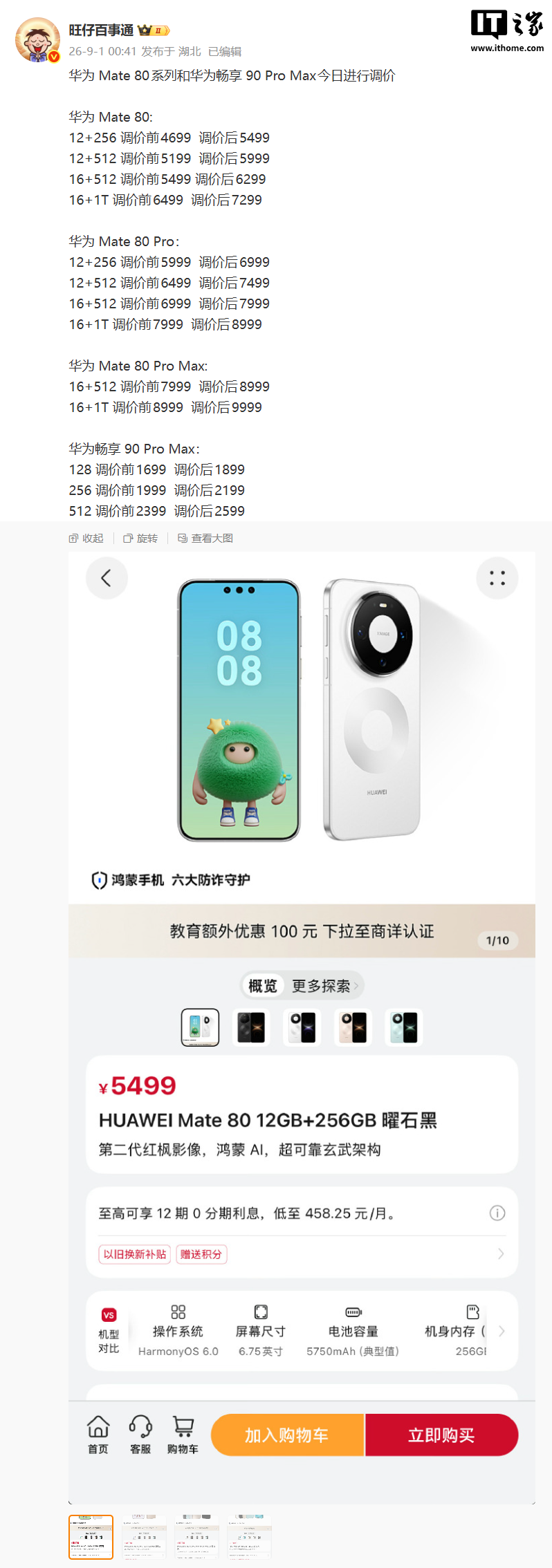
Huawei’s popular Mate 80 series and the Enjoy 90 Pro Max have experienced price increases across their configurations. The Mate 80 series, for instance, saw its 12GB+256GB variant rise from 4,699 yuan to 5,499 yuan, with other storage options following suit with similar percentage increases. The larger storage variants of the Mate 80 Pro and Pro Max also saw significant price jumps, pushing the top-tier 16GB+1TB model of the Pro Max to 9,999 yuan.
Similarly, Honor’s Power2 and Magic8 lines have also been affected. The Honor Power2’s 12GB+256GB model is now priced at 3,199 yuan, up from 2,699 yuan. The Magic8 series also saw its prices climb, with the 16GB+1TB configuration of the Magic8 now retailing for 5,999 yuan, an increase from 5,499 yuan.
Xiaomi and Redmi Models Affected
Xiaomi is also among the brands implementing price changes. The Xiaomi 17 series, including the Pro and Pro Max variants, along with the Xiaomi 17T, have all seen their starting prices increased. The base Xiaomi 17 model now starts at 5,099 yuan, up from 4,799 yuan.
The Redmi K90 series, specifically the K90 Max and K90 Ultra, are also affected by these price adjustments. The Redmi K90 Max now starts at 3,899 yuan, and the K90 Ultra at 3,699 yuan. Additionally, the Redmi Turbo 5 Max sees a price increase to 2,999 yuan.
Market Context: Rising Component Costs
These price adjustments are strongly linked to the anticipated increase in Qualcomm chip prices, which were projected to rise by double-digit percentages starting in September. This trend affects not only smartphones but also other tech gadgets. Furthermore, Xiaomi Group President Lu Weibing had previously indicated in late August that while memory price increases might slow down, costs would likely remain high for the latter half of the year.
This confluence of factors suggests a strategic response from manufacturers to offset rising production expenses, impacting consumers directly through higher retail prices across a range of popular devices. The market will be closely watching how these price changes affect consumer demand and competitive dynamics in the coming months.