Elon Musk has confirmed that SpaceX is planning to build its own gas turbine blade foundry in Bastrop, Texas. This strategic move aims to overcome a critical bottleneck in the expansion of AI data centers by enabling faster production of crucial components.
Addressing the Power Bottleneck
In a recent X post on August 30th, Musk revealed SpaceX’s intentions to construct a facility for casting both rotating blades (blades) and stationary blades (vanes) for gas turbines. This development comes as a response to the significant challenges in securing these components, which are essential for powering the energy-intensive AI infrastructure.
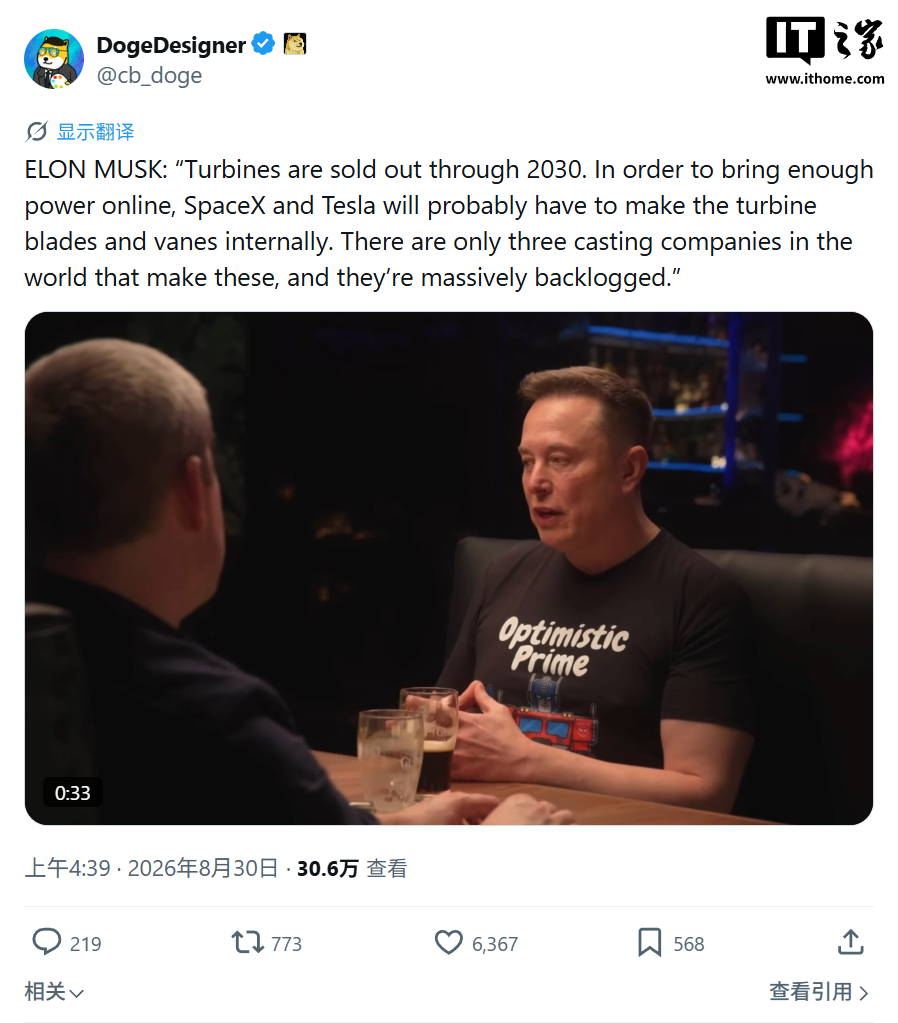
The manufacturing of large-scale gas turbine hot-end blades and impellers is a highly specialized process. Currently, only three foundries globally possess the capability to produce these parts, and their order books are filled through 2030. This scarcity has created a major bottleneck for the expanding AI industry, which requires immense power for its data centers.
The three foundries reportedly capable of this high-precision manufacturing are PCC (Precision Castparts Corp.), owned by Berkshire Hathaway; Howmet Aerospace, a spin-off from Alcoa; and the UK-based Doncasters Group. Together, PCC and Howmet Aerospace are said to dominate over 70% of the global gas turbine blade market.
Extreme Manufacturing Demands
The blades in question operate under extreme conditions, reaching temperatures between 3000–3600°F (approximately 1650–1980°C). This operating temperature is about 800°F higher than the melting point of the materials used, posing ultimate demands on advanced alloy casting techniques.
Musk had previously flagged the availability of these blades as a primary “limiting factor” in a podcast earlier this year. He expressed concerns that current production capacities might not be sufficient to provide enough power for all the AI chips being manufactured.
In-House Production as a Game-Changer
By bringing the casting of blades and guide vanes in-house, Musk believes SpaceX can accelerate the deployment of gas turbines by up to 18 months. He described this initiative as a “profound game-changer” for the industry.
This move is also part of a broader strategy to secure energy resources. Musk announced in his tweet that both SpaceX and Tesla are independently working on building solar production capacity totaling 100 GW annually. This massive solar energy expansion is expected to take approximately three years to complete.
The self-casting of turbine blades by SpaceX is a significant step towards mitigating supply chain dependencies and ensuring the rapid scaling of AI infrastructure, which relies heavily on powerful and reliable energy sources. This vertical integration could potentially reshape the landscape of energy supply for high-tech industries.