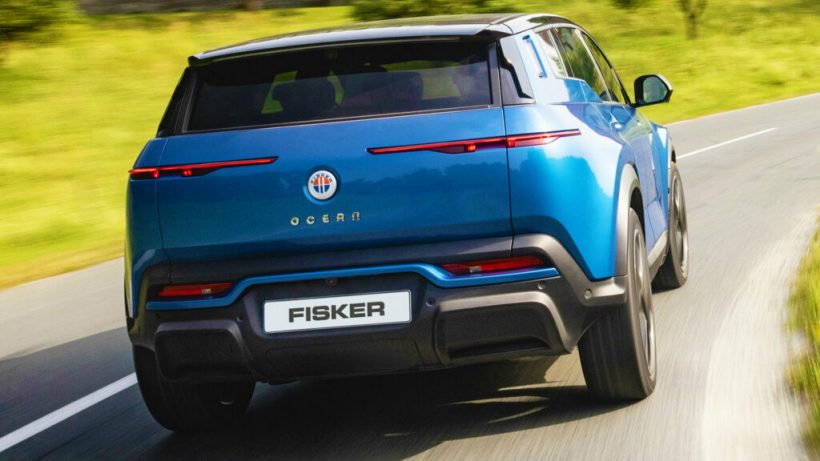
The bankruptcy proceedings for American EV startup Fisker in Sweden and Norway have concluded, approximately two years after the company filed for protection. While owners of the Fisker Ocean SUV are set to receive some compensation, the payout is significantly less than their initial claims.
Fisker’s Swedish Assets and Owner Payout
In Sweden, Fisker’s assets were valued at around 6 million Swedish kronor. After priority creditors were paid, approximately 2.5 million Swedish kronor remain to be distributed among affected Fisker Ocean owners who opt for a settlement. This means each owner could receive about 41,000 Swedish kronor (roughly $3,900 USD).
This amount is less than one-third of the original claims, which averaged 147,800 Swedish kronor per owner. These claims covered warranties, undelivered parts, and other obligations stemming from Fisker’s operations.
Norwegian Proceedings and Magna Steyr’s Role
The Norwegian bankruptcy proceedings revealed a total debt of 620 million Norwegian kroner. A significant portion, around 457 million Norwegian kroner, was owed to Magna Steyr, the company responsible for manufacturing the Fisker Ocean electric SUV.
Fisker’s History and Downfall
Founded by renowned automotive designer Henrik Fisker, who has a history of designing iconic vehicles like the BMW Z8 and Aston Martin DB9, Fisker Inc. aimed to establish itself as a major player in the electric vehicle market. This was not Fisker’s first foray into car manufacturing; his previous venture, Fisker Automotive, known for the Karma plug-in hybrid, filed for bankruptcy in 2013 and was later acquired by China’s Wanxiang Group, eventually becoming Karma Automotive.
In 2016, Henrik Fisker retained the ‘Fisker’ trademark and launched Fisker Inc., focusing on pure electric technology. The company went public in July 2020 through a SPAC merger, reaching a valuation close to $3 billion USD at the time.
However, Fisker Inc. filed for Chapter 11 bankruptcy protection in the U.S. on June 17, 2024. The company listed between 200 and 999 creditors, with liabilities estimated between $100 million and $500 million USD.
Failed Nissan Partnership and Asset Sales
A critical blow to Fisker was the collapse of negotiations with Nissan. Nissan had been considering a $400 million investment in exchange for licensing the company’s electric pickup platform, but the deal ultimately fell through, contributing significantly to Fisker’s demise.
Following the bankruptcy filing, Fisker’s liquidation plan was approved by the court in October 2024. To raise capital, Fisker sold approximately 3,300 vehicles to American Lease LLC for up to $46.25 million USD and transferred its intellectual property to creditors.
Fisker Ocean: Production Issues and Recalls
The Fisker Ocean, the company’s flagship pure electric SUV, was produced by Magna Steyr in Austria. Despite its potential, the vehicle faced challenges with slow production ramp-up and quality control issues. In 2023, over 10,000 Ocean vehicles were produced, but only about 4,700 were delivered.
Adding to the challenges, Fisker issued two recalls for all sold Ocean models in the U.S. within a month in June-July 2024, affecting approximately 7,500 vehicles. The recalls addressed potential software faults in the braking module that could lead to unintended reduction in regenerative braking, and a LIN6 bus communication failure that could cause the high-voltage battery management system to enter a ‘limp mode,’ severely reducing power output.
The Fate of “Orphan” Fisker Oceans
With Fisker’s bankruptcy, an estimated 12,000 Fisker Ocean SUVs were left as “orphan cars.” In response, owners have formed the Fisker Owners Association, an open-source community with around 4,000 members. This community is working to maintain the vehicles through reverse engineering, collective parts purchasing, and a mobile repair network, striving to keep the remaining vehicles operational.