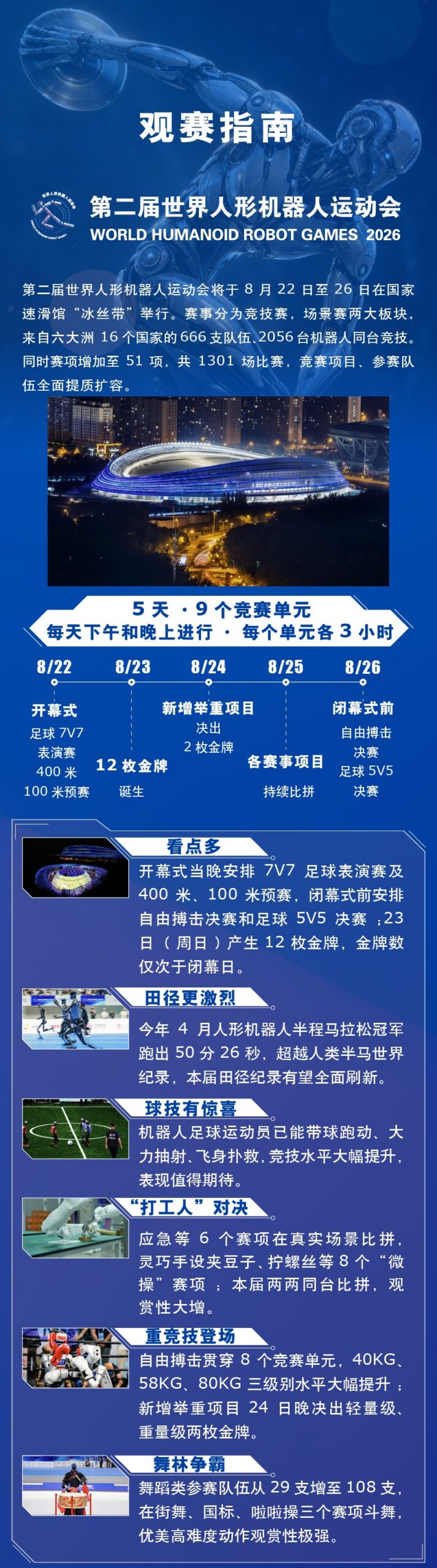
The second World Humanoid Robot Games kicked off today in Beijing, showcasing a significant expansion in scale and competition compared to its inaugural event. The games, scheduled to run until August 26th, feature a remarkable 51 events and over 1300 matches, drawing an impressive contingent of 666 teams and 2056 robots from across the globe.
Robots Get Competitive: New Challenges Emerge
This year’s competition introduces a host of new, high-intensity events designed to push the boundaries of humanoid robot capabilities. Spectators can look forward to thrilling displays of strength and agility in events like long jump, weightlifting, tug-of-war, and table tennis. These demanding challenges serve as a rigorous test of the robots’ ‘brains,’ coordination, structural integrity, and the performance of their core components.
The relentless pursuit of progress is evident in every centimeter jumped or kilogram lifted. These advancements are a direct result of engineers’ dedication to optimizing joint motors, gearboxes, and other critical parts through continuous design, precision manufacturing, and exhaustive testing.
Beyond the new power-focused events, the traditional track and field competitions are expected to be more fierce than ever. The robot soccer matches will see enhanced capabilities, including dribbling and powerful shots, while a ‘dance battle’ featuring hundreds of teams promises to be a captivating spectacle.
Scene Simulation: Robots in Real-World Scenarios
Complementing the athletic competitions, the ‘scene’ events have expanded to simulate real-world applications across various sectors, including industry, hospitality, and logistics. A particularly exciting addition is the ‘dexterous hand’ competition, which features eight intricate ‘micro-operation’ tasks, such as picking up beans and tightening screws, demonstrating fine motor skills.
A notable upgrade from last year is that scene competitions now feature robots competing head-to-head, rather than individual performances. This upgrade significantly enhances the excitement and watchability of these events, offering a more dynamic and engaging experience for the audience.
Global and Domestic Participation Soars
The World Humanoid Robot Games have attracted a truly international field, with 666 teams hailing from 16 countries across six continents. This represents a substantial 138% increase in team participation compared to the first games, with the number of robots quadrupling.
Robot-centric nations like the United States, Germany, and Japan are actively involved. Notably, Brazil has assembled a formidable national team, comprising five squads from their robot soccer World Cup entries.
Domestically, the event is a powerhouse of innovation, with 641 teams and 1975 robots entering from 157 companies, 200 educational institutions, and research organizations. This includes leading domestic tech companies and 27 ‘985 Project’ universities, highlighting a strong convergence of industry, academia, and research efforts.
Event Details
The main competition takes place at the National Speed Skating Oval, nicknamed the ‘Ice Ribbon,’ from August 22nd to 26th. The 51 events are divided into 30 competitive races and 21 scene challenges, with a total of 1301 matches scheduled.
The expanded program and increased participation underscore the growing global interest and rapid advancements in humanoid robotics. The games serve as a crucial platform for showcasing cutting-edge technology, fostering collaboration, and inspiring the next generation of robotic innovation.