
March 2026 marks a crystallization point for Ukraine’s tech sector. While the nation achieves 99% digitization of urban planning and global giants like SAP and Lenovo localize their AI power, a “relentless math” of vulnerabilities looms over the industry. Ukraine is striving to build an Agentic State—where AI doesn’t just assist but independently operates data—but the speed of this evolution comes with a price.
1. Transparency as a Foundation: 99% of Communities Digitized
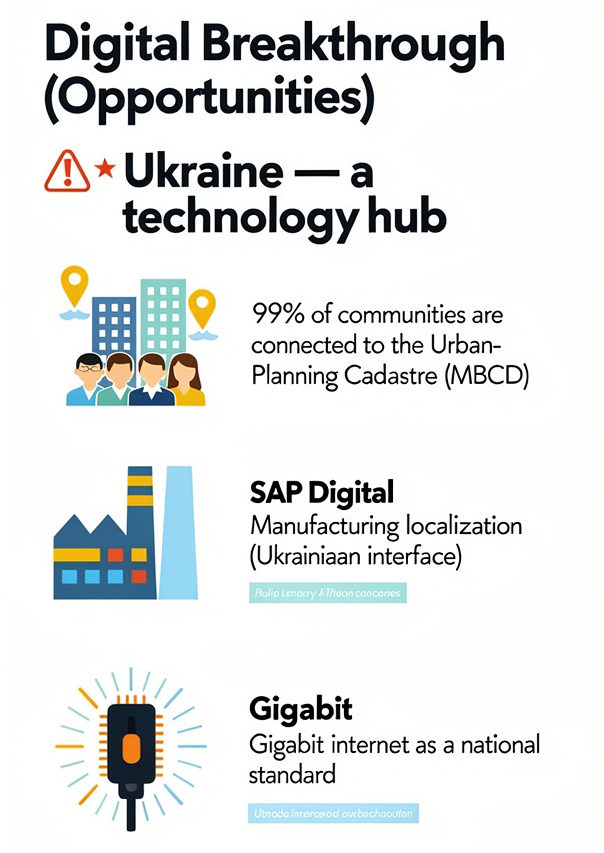
Ukraine has reached a historic milestone in urban transparency. 1,302 territorial communities (99%) now have access to the Unified State Electronic System in the construction sector.
-
The Goal: Ending the era of “hidden master plans.”
-
The Impact: As of March 17, 1,178 communities are actively using digital cabinets, creating a transparent track from project design to final expertise. This level of data integrity is crucial for attracting international reconstruction investors.
2. The Industrial AI Era: Lenovo and NVIDIA Gigafactories
The alliance between Lenovo and NVIDIA is launching the era of industrial enterprise AI. The Lenovo Hybrid AI Advantage™ on the NVIDIA Rubin platform allows Ukrainian enterprises to move computations from public clouds to local environments.
“Cost control and performance per token are becoming mission-critical,” says Yuanqing Yang, CEO of Lenovo. In the Agentic AI era, where workloads grow exponentially, these systems offer up to 8x lower cost per token compared to cloud IaaS.
3. SAP Localization: Ukrainian Digital Manufacturing
Global software is adapting to local needs. SAP has officially localized its Digital Manufacturing solution for Ukraine.
-
Native Integration: Taras Pylypets (SAP Ukraine) emphasizes that working in the Ukrainian language helps local teams integrate systems into production faster, aligning terminology with national industrial standards.
The “Relentless Math”: Security Debt as the Main Threat
Behind the facade of success lies a systemic failure in traditional security models. The State of Software Security (SoSS) 2026 report by Veracode delivers a harsh reality:
-
82% of organizations have accumulated “security debt”—vulnerabilities left unpatched for over a year.
-
The AI Wildcard: 86% of AI-generated code fails basic security tests.
This creates a “disturbing concentration of weaponizable flaws” that hackers are ready to exploit in real-time.
Comparison: The Digital Leap vs. The Security Gap
| Sector | Achievement 2026 | Critical Risk |
| Governance | 99% Digital Urban Cadastres | Data supply chain vulnerabilities |
| Industry | 8x cheaper AI tokens (Lenovo/NVIDIA) | AI-generated “toxic” code |
| Enterprise | Localized SAP Manufacturing | 82% of systems carry “Security Debt” |
Conclusion: Survival in the Age of the Agentic State
In 2026, Ukraine is a living laboratory for resilience—from gigabit internet standards to sovereign AI models. However, surviving this new reality requires a shift to “Emergency Triage.” Analysts suggest moving away from trying to fix everything and focusing strictly on protecting the most critical assets within the data supply chain.